
How Does Smart Auto Diagnosis in an AC Detect Problems?
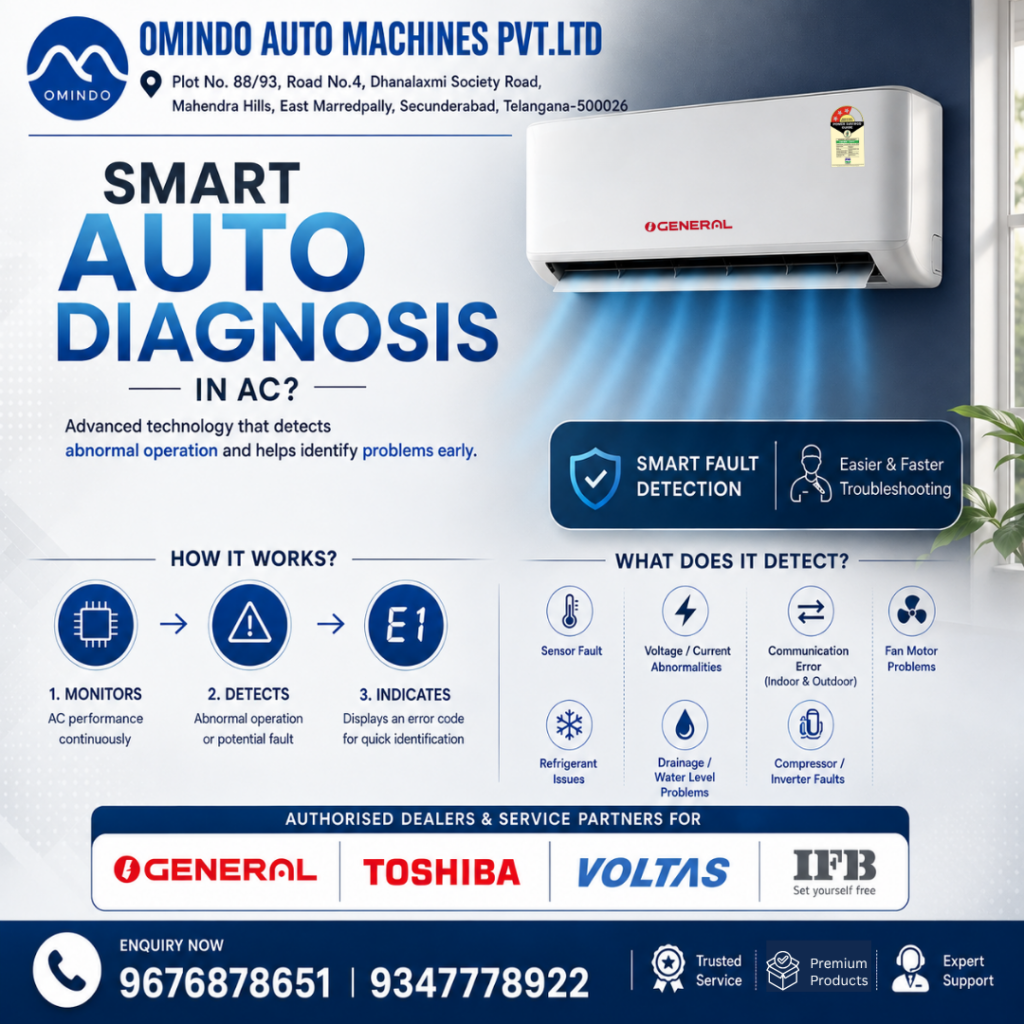
How Does Smart Auto Diagnosis in an AC Detect Problems? Smart auto diagnosis in an air conditioner detects problems by continuously monitoring important components such as temperature sensors, fan motors, voltage/current, communication between indoor and outdoor units, refrigerant-related conditions, drainage, and inverter/compressor operation. When the system notices an abnormal condition, it can trigger a fault indication or error code, helping technicians identify the possible problem faster. Modern AC systems can therefore move troubleshooting from “something is wrong” to “this particular system or component needs checking.” However, the exact error codes and detection capabilities vary by AC brand and model. What Is Smart Auto Diagnosis in an AC? An air conditioner is no longer just a cooling appliance. Modern inverter and smart AC systems contain multiple electronic controls and sensors that continuously monitor how the system is operating. Think of smart auto diagnosis as the AC’s internal monitoring system. Instead of waiting until the AC completely stops working, the system can identify abnormal operating conditions and provide an indication of what may be wrong. For example, an AC may detect: Sensor faults Abnormal voltage or current Indoor-outdoor communication errors Fan motor problems Refrigerant-related issues Drainage or water-level problems Compressor or inverter faults Temperature abnormalities Control-board or PCB-related faults Manufacturer documentation shows that modern systems can use specific error codes for issues such as sensor faults, communication failures, refrigerant shortage, voltage problems and fan motor faults. How Does AC Auto Diagnosis Work? The process is relatively simple to understand. 1. The AC continuously monitors its operation When the AC is running, sensors and electronic control systems monitor different operating parameters. For example, the system may monitor: Temperature → Voltage → Current → Fan operation → Refrigerant-related conditions → Indoor/outdoor communication → Compressor/inverter operation This happens automatically while the AC is operating. 2. The system identifies abnormal operation Suppose a temperature sensor sends an unusual reading. The AC’s control system compares that information with its expected operating conditions. If the reading falls outside the acceptable range, the system may identify it as a potential sensor or system fault. 3. The AC generates an error indication Depending on the model, the problem may appear as an error code, display indication, LED blinking pattern, or remote-controller diagnostic code. For example, Daikin documents diagnostic codes for conditions including refrigerant shortage, voltage problems, indoor-outdoor communication failures, fan motor faults and temperature-sensor faults. Some GENERAL air-conditioning systems also provide self-diagnosis information through compatible controls and service tools. 4. A technician uses the information for troubleshooting This is where auto diagnosis becomes particularly useful. Instead of checking every component randomly, a technician can start with the area indicated by the diagnostic information. Result: Fault detected → Error indication → Possible problem identified → Targeted inspection → Faster troubleshooting What Problems Can Smart Auto Diagnosis Detect? The exact list differs between models, but several common categories can be monitored. 1. Sensor Faults ACs use sensors to monitor temperatures and other operating conditions. If a sensor becomes disconnected, damaged or provides an abnormal reading, the system may generate a corresponding fault indication. For example, manufacturers document separate codes for indoor temperature sensors and heat-exchanger sensors. 2. Voltage and Current Abnormalities Electrical supply problems can affect air-conditioner operation. An AC may detect conditions such as: Overvoltage Undervoltage Excessive current Electrical protection activation For example, Daikin lists diagnostic codes associated with voltage drops, overvoltage and overcurrent conditions. This is particularly useful because repeatedly restarting an AC experiencing an electrical fault may not solve the underlying problem. 3. Indoor and Outdoor Communication Errors A split AC has an indoor unit and an outdoor unit that communicate with each other. If communication between them is interrupted because of a wiring, connection, control-board or related problem, the AC may report a communication fault. Modern systems can specifically identify indoor-outdoor communication errors. 4. Fan Motor Problems The indoor and outdoor units depend on fans for proper airflow and heat transfer. If a fan motor fails or abnormal operation is detected, the AC can generate a fault indication. This can help a technician focus on the fan motor, wiring, control board and related components rather than immediately assuming that the compressor is faulty. 5. Refrigerant-Related Problems Some modern AC systems can detect conditions associated with refrigerant shortage, restricted refrigerant flow or possible leakage. However, an error code should not automatically be interpreted as proof of a refrigerant leak. A technician may need to inspect the refrigerant circuit, pressure, connections and possible leakage points before confirming the actual cause. Samsung’s installation diagnostics, for example, include specific indications related to refrigerant flow and insufficient refrigerant. A Simple Real-World Example Imagine your AC suddenly stops cooling properly. Without diagnostic information, you might think: “Maybe the gas is low.” But poor cooling can have several possible causes. It could be: Dirty filters Poor airflow Sensor problems Fan problems Refrigerant-related issues Voltage problems Compressor/inverter problems Communication faults With a smart diagnostic system, the AC may provide a fault indication pointing the technician toward a particular system area. That doesn’t necessarily mean the repair is already identified, but it gives the technician a much better starting point. This distinction is important. Auto diagnosis helps identify and narrow down the problem. It does not magically repair the AC. How Much Time Can It Save? There is no universal number of minutes that every smart diagnosis system saves because troubleshooting time depends heavily on the AC model, fault, accessibility and technician’s experience. But the practical advantage is easy to understand. Traditional troubleshooting Customer complaint → General inspection → Test multiple components → Identify fault → Repair Diagnostic-assisted troubleshooting Customer complaint → Error indication → Identify suspected system → Test component → Repair A simple fault may take only a short inspection, while a complex PCB, inverter or compressor-related problem can require substantially more testing. So the biggest benefit isn’t necessarily a guaranteed “X-minute saving.” It is reducing unnecessary trial-and-error during diagnosis. Positive Side of Smart Auto Diagnosis ✅ Faster troubleshooting A technician gets useful diagnostic
How Does Smart Auto Diagnosis in an AC Detect Problems? Read More »