
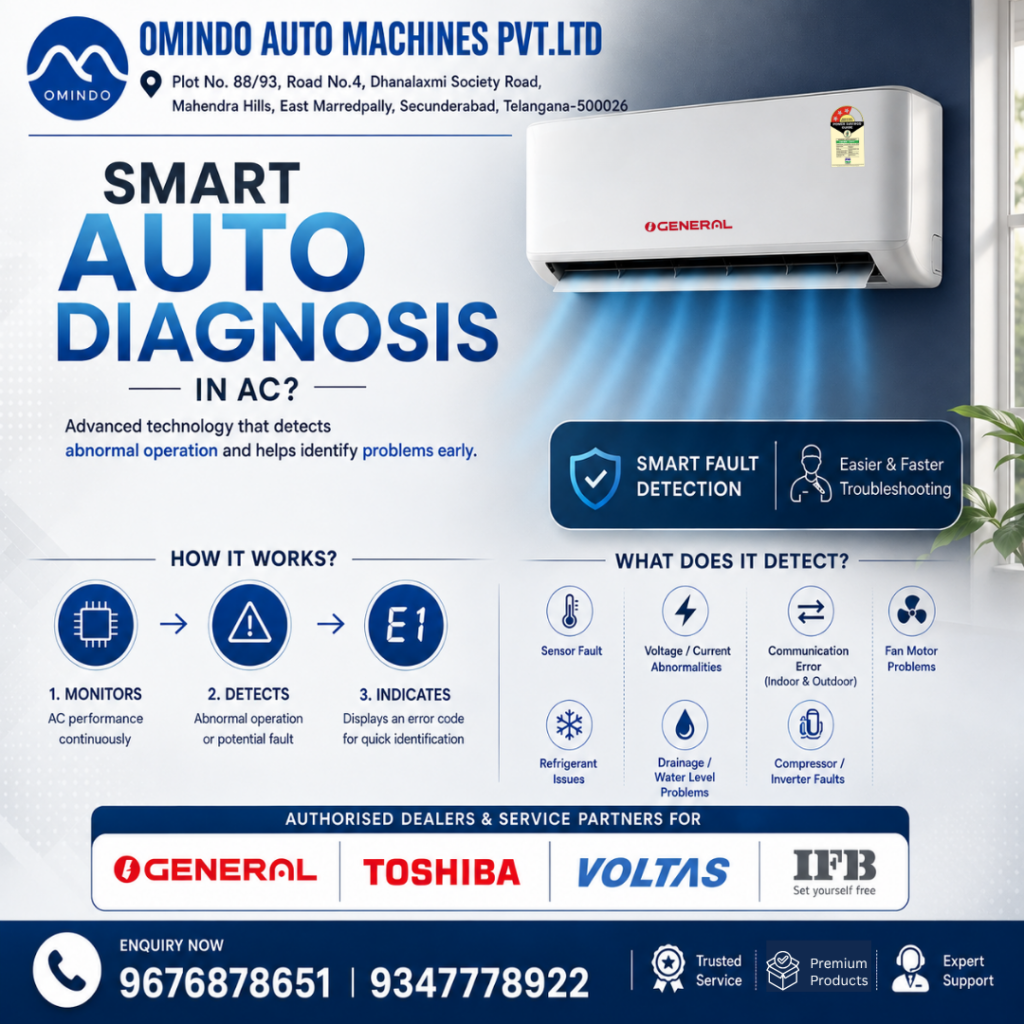
How Does Smart Auto Diagnosis in an AC Detect Problems?
Smart auto diagnosis in an air conditioner detects problems by continuously monitoring important components such as temperature sensors, fan motors, voltage/current, communication between indoor and outdoor units, refrigerant-related conditions, drainage, and inverter/compressor operation. When the system notices an abnormal condition, it can trigger a fault indication or error code, helping technicians identify the possible problem faster. Modern AC systems can therefore move troubleshooting from “something is wrong” to “this particular system or component needs checking.” However, the exact error codes and detection capabilities vary by AC brand and model.
What Is Smart Auto Diagnosis in an AC?
An air conditioner is no longer just a cooling appliance. Modern inverter and smart AC systems contain multiple electronic controls and sensors that continuously monitor how the system is operating.
Think of smart auto diagnosis as the AC’s internal monitoring system.
Instead of waiting until the AC completely stops working, the system can identify abnormal operating conditions and provide an indication of what may be wrong.
For example, an AC may detect:
- Sensor faults
- Abnormal voltage or current
- Indoor-outdoor communication errors
- Fan motor problems
- Refrigerant-related issues
- Drainage or water-level problems
- Compressor or inverter faults
- Temperature abnormalities
- Control-board or PCB-related faults
Manufacturer documentation shows that modern systems can use specific error codes for issues such as sensor faults, communication failures, refrigerant shortage, voltage problems and fan motor faults.
How Does AC Auto Diagnosis Work?
The process is relatively simple to understand.
1. The AC continuously monitors its operation
When the AC is running, sensors and electronic control systems monitor different operating parameters.
For example, the system may monitor:
Temperature → Voltage → Current → Fan operation → Refrigerant-related conditions → Indoor/outdoor communication → Compressor/inverter operation
This happens automatically while the AC is operating.
2. The system identifies abnormal operation
Suppose a temperature sensor sends an unusual reading.
The AC’s control system compares that information with its expected operating conditions.
If the reading falls outside the acceptable range, the system may identify it as a potential sensor or system fault.
3. The AC generates an error indication
Depending on the model, the problem may appear as an error code, display indication, LED blinking pattern, or remote-controller diagnostic code.
For example, Daikin documents diagnostic codes for conditions including refrigerant shortage, voltage problems, indoor-outdoor communication failures, fan motor faults and temperature-sensor faults.
Some GENERAL air-conditioning systems also provide self-diagnosis information through compatible controls and service tools.
4. A technician uses the information for troubleshooting
This is where auto diagnosis becomes particularly useful.
Instead of checking every component randomly, a technician can start with the area indicated by the diagnostic information.
Result:
Fault detected → Error indication → Possible problem identified → Targeted inspection → Faster troubleshooting
What Problems Can Smart Auto Diagnosis Detect?
The exact list differs between models, but several common categories can be monitored.
1. Sensor Faults
ACs use sensors to monitor temperatures and other operating conditions.
If a sensor becomes disconnected, damaged or provides an abnormal reading, the system may generate a corresponding fault indication.
For example, manufacturers document separate codes for indoor temperature sensors and heat-exchanger sensors.
2. Voltage and Current Abnormalities
Electrical supply problems can affect air-conditioner operation.
An AC may detect conditions such as:
- Overvoltage
- Undervoltage
- Excessive current
- Electrical protection activation
For example, Daikin lists diagnostic codes associated with voltage drops, overvoltage and overcurrent conditions.
This is particularly useful because repeatedly restarting an AC experiencing an electrical fault may not solve the underlying problem.
3. Indoor and Outdoor Communication Errors
A split AC has an indoor unit and an outdoor unit that communicate with each other.
If communication between them is interrupted because of a wiring, connection, control-board or related problem, the AC may report a communication fault.
Modern systems can specifically identify indoor-outdoor communication errors.
4. Fan Motor Problems
The indoor and outdoor units depend on fans for proper airflow and heat transfer.
If a fan motor fails or abnormal operation is detected, the AC can generate a fault indication.
This can help a technician focus on the fan motor, wiring, control board and related components rather than immediately assuming that the compressor is faulty.
5. Refrigerant-Related Problems
Some modern AC systems can detect conditions associated with refrigerant shortage, restricted refrigerant flow or possible leakage.
However, an error code should not automatically be interpreted as proof of a refrigerant leak.
A technician may need to inspect the refrigerant circuit, pressure, connections and possible leakage points before confirming the actual cause.
Samsung’s installation diagnostics, for example, include specific indications related to refrigerant flow and insufficient refrigerant.
A Simple Real-World Example
Imagine your AC suddenly stops cooling properly.
Without diagnostic information, you might think:
“Maybe the gas is low.”
But poor cooling can have several possible causes.
It could be:
- Dirty filters
- Poor airflow
- Sensor problems
- Fan problems
- Refrigerant-related issues
- Voltage problems
- Compressor/inverter problems
- Communication faults
With a smart diagnostic system, the AC may provide a fault indication pointing the technician toward a particular system area.
That doesn’t necessarily mean the repair is already identified, but it gives the technician a much better starting point.
This distinction is important.
Auto diagnosis helps identify and narrow down the problem. It does not magically repair the AC.
How Much Time Can It Save?
There is no universal number of minutes that every smart diagnosis system saves because troubleshooting time depends heavily on the AC model, fault, accessibility and technician’s experience.
But the practical advantage is easy to understand.
Traditional troubleshooting
Customer complaint → General inspection → Test multiple components → Identify fault → Repair
Diagnostic-assisted troubleshooting
Customer complaint → Error indication → Identify suspected system → Test component → Repair
A simple fault may take only a short inspection, while a complex PCB, inverter or compressor-related problem can require substantially more testing.
So the biggest benefit isn’t necessarily a guaranteed “X-minute saving.”
It is reducing unnecessary trial-and-error during diagnosis.
Positive Side of Smart Auto Diagnosis
✅ Faster troubleshooting
A technician gets useful diagnostic information before beginning extensive testing.
✅ Better fault identification
Error codes can help distinguish between different categories of problems.
✅ Easier maintenance
Recurring fault patterns can provide useful information about the AC’s operating condition.
✅ Reduced guesswork
Instead of replacing parts based purely on symptoms, technicians can investigate the indicated system first.
✅ Better customer communication
A technician can explain what the AC is reporting and what needs to be inspected.
✅ Useful for complex inverter ACs
Modern inverter systems contain more electronic controls than conventional ACs, making systematic diagnosis particularly valuable.
GENERAL, for example, provides a technician tool that includes error-message information, thermistor resistance and pressure-related checks along with troubleshooting charts.
Are There Any Limitations?
Yes. Smart auto diagnosis is useful, but it should not be treated as a complete replacement for professional inspection.
❌ An error code does not always identify the exact failed part
One fault indication can have multiple possible causes.
For example, a communication problem could require checking wiring, connections, power supply and control boards.
❌ Different brands use different codes
An E1 or another code does not necessarily mean the same thing across different AC brands or models.
Even manufacturers caution that diagnostic-code formats and meanings can vary by model.
❌ Some problems require physical inspection
PCB damage, refrigerant leakage, loose wiring, compressor problems and electrical faults may require specialized instruments and trained technicians.
❌ It cannot prevent every AC failure
Auto diagnosis can detect certain abnormal conditions, but it cannot guarantee that every developing mechanical or electrical problem will be detected before failure.
Should You Reset the AC When an Error Appears?
A temporary electrical or operational abnormality can sometimes clear after the AC is switched off and restarted, depending on the model and fault.
However, repeatedly resetting an AC is not a substitute for diagnosis.
If the same error returns, the underlying issue should be investigated.
For example, Samsung’s troubleshooting guidance distinguishes between temporary voltage-related errors that disappear after restarting and recurring faults that require further inspection.
If the fault involves electrical components, the inverter, PCB, compressor or refrigerant circuit, it is safer to have a qualified technician inspect the system rather than opening the unit yourself.
Smart Diagnosis vs Traditional AC Troubleshooting
| Feature | Traditional Troubleshooting | Smart Auto Diagnosis |
|---|---|---|
| Fault indication | Mainly based on symptoms | Error code/diagnostic indication may be available |
| Initial diagnosis | Manual inspection | System provides additional information |
| Troubleshooting | Can involve multiple checks | Can narrow the inspection area |
| Error identification | Depends heavily on technician | Diagnostic system assists technician |
| Complex inverter systems | More testing may be required | Useful diagnostic information can be available |
| Repair | Still requires technician | Still requires technician |
The key point is that smart diagnosis assists the technician rather than replacing the technician.
Why Smart Auto Diagnosis Is Useful for AC Owners
Imagine two situations.
Situation 1: AC simply stops working
You call a technician and explain:
“The AC isn’t working.”
The technician has to start investigating the system.
Situation 2: AC reports a specific diagnostic fault
You can provide the technician with the displayed code or fault indication.
The technician now has additional information before beginning the inspection.
That small difference can make the service process more organized and efficient.
What Should You Do When Your AC Shows an Error?
Follow these basic steps:
1. Note the error code or LED pattern.
2. Check your AC’s user manual for the specific code.
3. Turn the AC off if the manufacturer recommends doing so.
4. Avoid repeatedly restarting the unit if the error keeps returning.
5. Contact a qualified AC technician for persistent faults.
6. Share the model number and error indication with the technician.
This information can help the technician prepare for the service visit.
Final Takeaway
Smart auto diagnosis makes modern air-conditioner troubleshooting more systematic by continuously monitoring important operating parameters and reporting abnormal conditions through error codes or other diagnostic indicators. It can help identify possible sensor, voltage, communication, fan, refrigerant and inverter-related problems and give technicians a more focused starting point.
But remember: an error code is a diagnostic clue, not a complete repair diagnosis. The actual cause may require electrical measurements, sensor testing, refrigerant checks or inspection of the PCB and other components.
For AC owners, the biggest advantage is simple: your AC can tell the technician more about what is going wrong before the troubleshooting process even begins.
Frequently Asked Questions
Does every AC have smart auto diagnosis?
No. Diagnostic features vary by brand, model and AC type.
Can an AC diagnose a refrigerant leak automatically?
Some systems can detect conditions associated with refrigerant shortage or leakage, but confirmation may require professional testing.
Does an AC error code tell me exactly what part to replace?
Not necessarily. An error code generally identifies a fault condition or system area. Further testing may be required to identify the failed component.
Can I fix an AC error code myself?
Simple user-level checks may sometimes be appropriate, but electrical, refrigerant, inverter, compressor and PCB-related faults should be handled by a qualified technician.
Why is smart auto diagnosis important in inverter ACs?
Inverter ACs contain sophisticated electronic controls and multiple sensors. Diagnostic information can help technicians systematically investigate these systems instead of relying only on the cooling symptom.
Can smart diagnosis prevent AC breakdowns?
It can help identify certain abnormal operating conditions early, but it cannot guarantee that every failure will be detected or prevented.
Our OGeneral Showroom at : 37-127/4/1, Neredmet X Rd, Gandhi Nagar, A. S. Rao Nagar, Secunderabad, Telangana 500056
Our Voltas Showroom at : Sh no 2/3/4, Rd Number 56, Ayyappa Society, Mega Hills, Madhapur, Hyderabad, Telangana 500081
Follow us for more at @omindoautomachines_hyd, fb: Omindo Auto Machines Pvt Ltd.
Our Products : Air Conditioners | Televisions | Refrigerators | Kitchen Hobs | Chimneys | Chest freezers | VRF Services