 OMINDO
What Is Self Cleaning in AC? Benefits & How It Works
What Is Self Cleaning in AC? Benefits, How It Works & Maintenance Guide
Self cleaning in AC automatically cleans and dries the indoor evaporator coil.
If you have recently purchased or researched an air conditioner, you may have noticed features such as “Self Clean,” “Auto Clean,” “Self Cleaning Technology,” or “Self Cleaning AC.” But what does this feature actually do? Does the AC really clean itself? Does it eliminate the need for servicing? Can it improve cooling and reduce electricity consumption?
The short answer is that self-cleaning technology is designed to clean and dry the indoor evaporator coil automatically, helping reduce the accumulation of moisture, dust, and other contaminants inside the indoor unit.
However, self cleaning does not mean that an AC becomes completely maintenance-free. Understanding how the technology works and what it can—and cannot—do is important before choosing an AC with this feature.
In this detailed guide, we will explain what self cleaning in AC means, how the process works, its benefits, limitations, effect on cooling and energy efficiency, and how it differs from normal AC cleaning.
What Is Self Cleaning in AC?
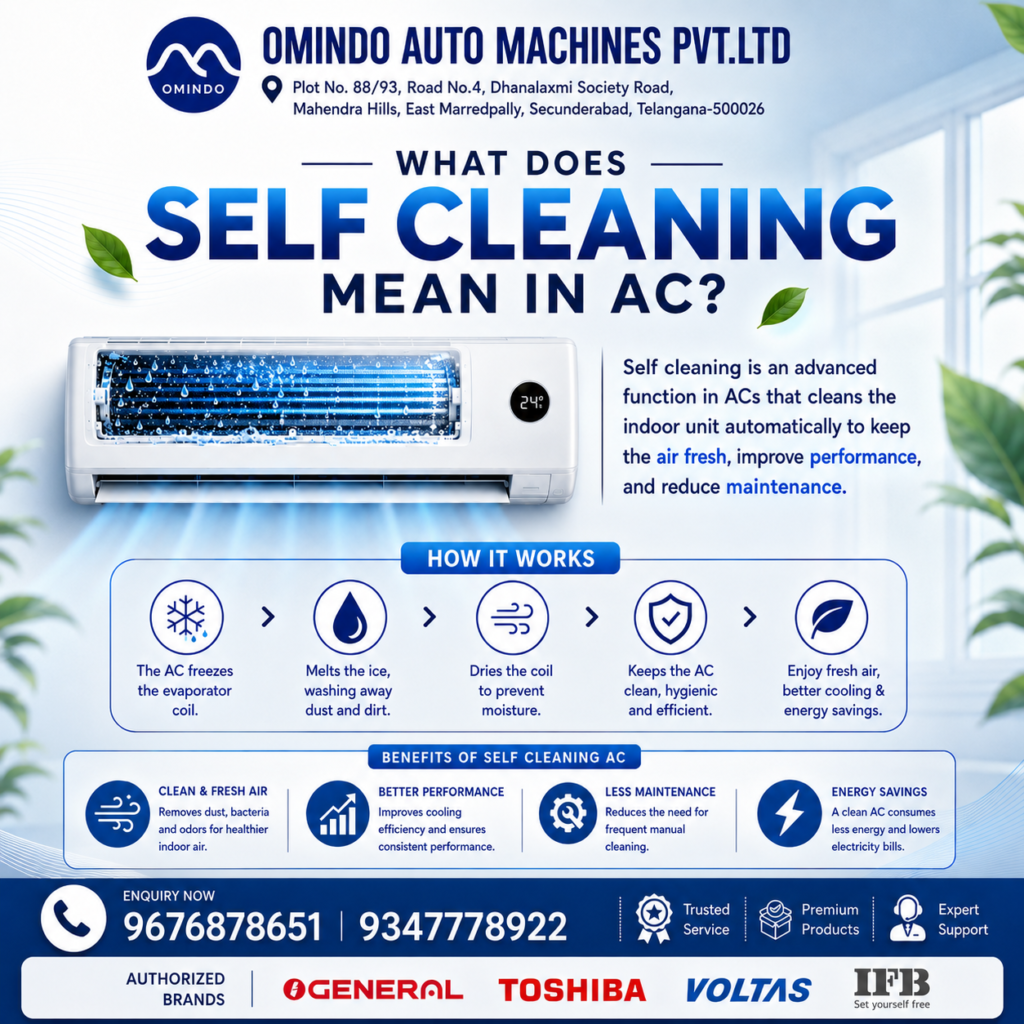
Self cleaning in an AC is an automatic function that helps clean and dry the indoor evaporator coil using the AC’s own cooling and drying cycle.
During normal operation, an AC continuously handles warm and humid air. When this air passes over the cold evaporator coil, moisture from the air condenses on the coil.
This moisture is normal and necessary for the cooling process. However, when moisture remains inside the indoor unit along with dust and other particles, it can create conditions where unwanted buildup may occur.
The self-cleaning function is designed to address this problem.
Depending on the AC manufacturer and model, the exact process can differ, but the basic principle generally involves:
Freezing → Melting → Washing → Drying
The purpose is to help remove accumulated particles and moisture from the evaporator coil and leave the indoor unit cleaner and drier.
Why Does an AC Need Self Cleaning?
To understand self cleaning, we first need to understand what happens inside an AC.
When you switch on your AC, warm indoor air is pulled into the indoor unit.
The air passes over the evaporator coil, which contains cold refrigerant. Heat from the indoor air is absorbed by the refrigerant, and cooler air is then circulated back into the room.
At the same time, moisture in the air can condense on the cold coil.
So, during normal AC operation, the indoor coil can become:
- Wet
- Dusty
- Moisture-laden
- Exposed to airborne particles
- Difficult to access for everyday cleaning
If the coil is not maintained properly, accumulated dirt can interfere with airflow and heat transfer.
This is one reason why regular AC maintenance remains important even when the AC has a self-cleaning function.
How Does Self Cleaning in AC Work?
The self-cleaning process can generally be understood in 5 stages.
1. The AC Freezes the Evaporator Coil
During the self-cleaning cycle, the AC may operate its cooling system in a way that causes the evaporator coil to become extremely cold.
This can create a layer of ice or frost on the coil.
Why is this useful?
The ice can help loosen dust and other particles attached to the surface of the coil.
Think of it as preparing the accumulated dirt for the next stage of the cleaning process.
2. The Ice Melts
After the freezing stage, the AC stops the freezing process and allows the accumulated ice to melt.
As the ice melts, the resulting water moves across the evaporator coil.
This water can help carry loosened dust and particles toward the drainage system.
This is one of the key principles behind many self-cleaning AC systems.
In simple terms:
Freeze → loosen dirt → melt → wash away dirt
The exact sequence and operation can vary by manufacturer, so users should always refer to the specific AC model’s manual.
3. The Coil Is Dried
After the washing process, moisture needs to be removed.
The AC therefore enters a drying stage.
Drying the indoor coil is important because simply removing dust is not the only objective.
A wet indoor coil can retain moisture after cooling operation. The self-cleaning process therefore attempts to leave the coil drier after the cycle.
This is particularly useful in environments where humidity is relatively high.
4. The Indoor Unit Remains Cleaner
After the self-cleaning cycle is completed, the evaporator coil can be cleaner than it was before the cycle.
This can help reduce the accumulation of dust and moisture between manual cleaning sessions.
However, it is important to understand the distinction:
Self cleaning helps maintain the indoor coil; it does not replace complete professional AC servicing.
Filters, drain pipes, blower components, outdoor units, electrical components, and other parts still require appropriate inspection and maintenance.
5. The AC Continues Normal Operation
Once the self-cleaning cycle is complete, the AC returns to normal operation.
The intended result is an indoor unit that is:
Cleaner + Drier + Better maintained
This can support consistent cooling performance when combined with proper filter cleaning and regular servicing.
What Are the Benefits of Self Cleaning AC?
Self-cleaning technology can offer 4 major benefits for AC users.
1. Cleaner and Fresher Indoor Air
An AC continuously circulates indoor air.
Dust and airborne particles can accumulate on various parts of the indoor unit, including the evaporator coil.
By helping clean the coil, self-cleaning technology can support a cleaner indoor environment.
However, it should not be considered an air purifier or a replacement for proper indoor air-quality measures.
For better indoor air quality, users should also:
- Clean AC filters regularly
- Maintain proper ventilation
- Control indoor dust
- Keep the room clean
- Service the AC when required
2. Better Cooling Performance
A clean evaporator coil is important for efficient heat exchange.
When the coil becomes heavily contaminated with dust, airflow and heat transfer can be affected.
A cleaner coil can therefore help the AC maintain its intended cooling performance.
For example, imagine two identical ACs operating under similar conditions.
AC A
- Clean filter
- Relatively clean evaporator coil
- Good airflow
- Proper maintenance
AC B
- Dirty filter
- Dust accumulation
- Restricted airflow
- Poor maintenance
Even though both ACs have the same cooling capacity, their real-world performance can differ.
This is why maintaining the heat-transfer surfaces inside an AC matters.
3. Reduced Manual Cleaning Frequency
One of the biggest advantages of self cleaning is convenience.
Normally, the indoor coil requires cleaning during AC maintenance.
With a self-cleaning function, the AC can perform an automatic cleaning cycle without requiring the user to manually access the evaporator coil every time.
This can help reduce the accumulation of dirt between professional service visits.
But remember:
Self cleaning ≠ zero maintenance
You should still:
- Clean the air filter
- Check the drain
- Inspect the indoor unit
- Clean the outdoor unit when required
- Check refrigerant performance when necessary
- Schedule professional servicing periodically
4. Potential Energy Efficiency Benefits
This is one area where users should be careful with marketing claims.
A dirty AC coil can negatively affect heat transfer and airflow, potentially making the system work harder to deliver the required cooling.
Keeping the coil reasonably clean can therefore support efficient operation.
However, there is no universal percentage of electricity savings that applies to every self-cleaning AC.
For example, you may see claims such as:
- 10% savings
- 20% savings
- 30% savings
But these numbers should not automatically be applied to every AC.
Actual electricity consumption depends on many factors, including:
- AC capacity
- Energy-efficiency rating
- Compressor technology
- Room size
- Outdoor temperature
- Indoor temperature
- Humidity
- Usage hours
- Temperature setting
- Number of occupants
- Insulation
- Door and window openings
- Filter condition
- Coil condition
Therefore, the more accurate statement is:
A cleaner AC can support efficient operation, but actual energy savings vary by operating conditions and AC model.
Self Cleaning AC vs Normal AC Cleaning
These two concepts are often confused.
| Self Cleaning Function | Manual/Professional Cleaning |
|---|---|
| Automatic process | Performed manually |
| Mainly helps clean the indoor coil | Can clean multiple AC components |
| Convenient for routine maintenance | More comprehensive |
| Takes place using the AC’s internal cycle | Uses cleaning tools/equipment |
| Helps reduce moisture and buildup | Can remove heavier dirt and deposits |
| Cannot replace servicing | Required when deeper cleaning is needed |
The easiest way to remember this is:
Self cleaning = routine assistance
Professional servicing = comprehensive maintenance
Both can be important.
Does Self Cleaning Mean You Never Need AC Servicing?
No.
This is one of the biggest misconceptions about self-cleaning ACs.
Self-cleaning technology is a feature designed to help maintain the indoor coil.
It does not automatically:
- Repair refrigerant leaks
- Fix electrical problems
- Clean every component
- Repair drainage blockages
- Replace damaged parts
- Clean the entire outdoor unit
- Fix compressor problems
- Correct airflow problems caused by other components
Professional servicing may still be necessary depending on the AC’s condition and usage.
How Often Should You Clean an AC Filter?
The air filter is different from the evaporator coil.
The filter captures dust and particles before air reaches the internal components.
If the filter becomes heavily blocked, airflow can decrease.
Therefore, users should inspect and clean the filter regularly.
The ideal frequency depends on:
- Dust levels
- Usage hours
- Indoor air conditions
- Presence of pets
- Construction activity nearby
- Local environmental conditions
A household in a dusty environment may need more frequent filter cleaning than a household in a relatively clean environment.
Does Self Cleaning Improve AC Cooling?
It can help maintain cooling performance by keeping the evaporator coil cleaner, but it should not be interpreted as a technology that increases the AC’s rated cooling capacity.
For example, a 1.5-ton AC does not become a 2-ton AC because of self-cleaning technology.
Instead, the feature helps the existing cooling system operate under cleaner conditions.
This distinction is important.
Self cleaning does:
Maintain → Clean → Dry → Support performance
Self cleaning does not:
Increase the rated tonnage of the AC
Does Self Cleaning Remove All Dust From an AC?
Not necessarily.
Self-cleaning systems are designed primarily around specific components and cleaning mechanisms.
The effectiveness depends on:
- AC design
- Manufacturer
- Model
- Cleaning cycle
- Type of contamination
- Amount of accumulated dirt
- Condition of the drainage system
Heavy dirt, grease, mold-like buildup, or contamination in inaccessible areas may still require manual cleaning.
Therefore, users should not assume that running the self-cleaning function once will completely clean the entire AC.
How Long Does AC Self Cleaning Take?
The duration depends on the AC manufacturer and model.
Some systems may complete their self-cleaning process relatively quickly, while others may take longer because the process involves multiple stages.
The important point is that there is no single universal duration for every self-cleaning AC.
Always check the product manual for the exact operating procedure and duration.
When Should You Use the Self Cleaning Function?
Self cleaning is generally useful after regular cooling operation, especially when the AC has been operating frequently.
For example:
During regular usage
Use the self-cleaning function according to the manufacturer’s recommended procedure.
After extended usage
A self-cleaning cycle can help maintain the indoor coil.
Before long periods of non-use
Some AC manufacturers may recommend specific cleaning/drying procedures before extended shutdown.
Again, the exact recommendation depends on the model.
Is Self Cleaning AC Worth Buying?
For many users, yes, it can be a useful feature, particularly if convenience and indoor-unit maintenance are important.
However, it should not be the only factor when choosing an AC.
When buying an AC, also consider:
1. Energy efficiency
Look at the relevant efficiency rating and expected electricity consumption.
2. Cooling capacity
Choose the appropriate capacity for your room size and conditions.
3. Compressor technology
Understand whether the model uses inverter or non-inverter technology and what that means for your usage.
4. Service network
A good service network can be just as important as the AC’s specifications.
5. Warranty
Check the warranty terms for the compressor, PCB, and other components.
6. Self-cleaning technology
Consider it as an additional maintenance and convenience feature rather than the sole reason to purchase the AC.
5 Important Things to Know About Self Cleaning AC
Before buying a self-cleaning AC, remember these 5 points:
1. Self cleaning is mainly intended to maintain the indoor coil.
2. It can help reduce moisture and dirt accumulation.
3. It may support consistent cooling performance when the AC is properly maintained.
4. It does not guarantee a fixed percentage of electricity savings.
5. It does not eliminate the need for professional AC servicing.
Self Cleaning AC: A Simple Example
Consider an AC operating for several hours every day.
During cooling:
Warm air enters → Air passes over the cold coil → Heat is removed → Moisture condenses → Cool air returns to the room
Over time:
Dust + moisture + regular operation → buildup on internal surfaces
The self-cleaning process attempts to address this through:
Freezing → Melting → Washing → Drying
The goal is to maintain a cleaner indoor coil and reduce moisture retention.
Self Cleaning AC and Hyderabad’s Climate
In regions such as Hyderabad, ACs can experience significant usage during hot months.
High temperatures can lead to longer cooling hours, while dust in the surrounding environment can also contribute to the accumulation of particles on AC filters and internal components.
For such conditions, self-cleaning technology can be a useful convenience feature.
However, users should still pay attention to:
- Filter cleaning
- Drainage
- Outdoor-unit cleanliness
- Cooling performance
- Unusual noises
- Water leakage
- Electricity consumption
- Professional servicing
The self-cleaning function should be treated as one part of AC maintenance—not the entire maintenance system.
Common Myths About Self Cleaning AC
Myth 1: “Self cleaning means the AC never needs servicing.”
False.
Self cleaning helps with the indoor coil but does not replace comprehensive maintenance.
Myth 2: “Self cleaning guarantees 30% electricity savings.”
Not necessarily.
There is no universal savings percentage. Actual electricity consumption depends on the AC and operating conditions.
Myth 3: “Self cleaning removes every type of dirt.”
False.
The technology has limitations and may not remove heavy contamination or dirt from every component.
Myth 4: “Self cleaning is the same as air purification.”
False.
Self cleaning focuses on maintaining the AC’s internal components. It is not equivalent to an air purifier or dedicated air-filtration technology.
Myth 5: “If I have self cleaning, I don’t need to clean the filter.”
False.
The filter still requires regular inspection and cleaning.
Frequently Asked Questions
What is self cleaning in AC?
Self cleaning is an AC function that automatically cleans and dries the indoor evaporator coil using a specialized operating cycle.
Is self cleaning good for AC?
Yes. It can help maintain a cleaner and drier indoor coil and support consistent AC performance.
Does self cleaning reduce electricity consumption?
It can support efficient operation by helping maintain a cleaner coil, but actual electricity savings vary and cannot be guaranteed as a fixed percentage.
Does self cleaning remove bacteria?
Some manufacturers may make specific hygiene-related claims for their technology. Users should refer to the individual model’s certified specifications rather than assuming that every self-cleaning AC eliminates bacteria.
Does self cleaning remove bad smell from AC?
It may help reduce odors associated with moisture and buildup on the indoor coil, but persistent odors can have other causes and may require professional cleaning.
How often should I use self cleaning in AC?
Follow the manufacturer’s recommendation. The appropriate frequency can depend on the model, usage, humidity, and environmental conditions.
Does self cleaning replace professional servicing?
No. Professional maintenance may still be required for deeper cleaning, inspection, drainage, electrical components, refrigerant performance, and other parts.
Is self cleaning available in all ACs?
No. Self-cleaning technology is available only in models that specifically include the feature.
Final Takeaway: Is Self Cleaning in AC Useful?
Self cleaning is a useful AC maintenance feature that helps clean and dry the indoor evaporator coil automatically.
The technology generally works through a multi-stage process involving freezing, melting, washing, and drying. Its primary purpose is to reduce the accumulation of dust and moisture on the indoor coil and help maintain the AC’s performance.
The 4 major benefits are:
- Cleaner and fresher indoor air
- Better cooling performance
- Reduced need for frequent manual coil cleaning
- Potential support for energy-efficient operation
But the most important point is this:
Self-cleaning technology makes AC maintenance easier; it does not make the AC maintenance-free.
For the best results, combine the self-cleaning function with regular filter cleaning, proper usage, drainage checks, and professional servicing when required.
If you’re comparing ACs, don’t look at self cleaning in isolation. Consider the complete package—energy efficiency, cooling capacity, compressor technology, service support, warranty, maintenance requirements, and overall running cost.
Our OGeneral Showroom at : 37-127/4/1, Neredmet X Rd, Gandhi Nagar, A. S. Rao Nagar, Secunderabad, Telangana 500056
Our Voltas Showroom at : Sh no 2/3/4, Rd Number 56, Ayyappa Society, Mega Hills, Madhapur, Hyderabad, Telangana 500081
Follow us for more at @omindoautomachines_hyd, fb: Omindo Auto Machines Pvt Ltd.
Our Products : Air Conditioners | Televisions | Refrigerators | Kitchen Hobs | Chimneys | Chest freezers | VRF