 OMINDO
How to Choose the Right AC Capacity for Your Room
How to Choose the Right AC Capacity for Your Room
Choosing the right AC capacity is more important than simply choosing a bigger AC. As a practical starting point, a 1-ton AC is commonly suitable for smaller rooms around 50–120 sq. ft., while a 1.5-ton AC is generally suitable for medium-sized rooms around 120–170/180 sq. ft. However, room size alone is not enough. Sun exposure, ceiling height, number of occupants, windows, floor level, heat-generating appliances and the local climate can change the actual cooling requirement. For an accurate selection, the room’s heat load should be considered rather than relying only on a square-foot thumb rule.
What Does AC Tonnage Actually Mean?
One of the biggest misunderstandings when buying an air conditioner is the word “ton.”
In AC terminology, tonnage does not refer to the weight of the air conditioner. It represents the cooling capacity of the system.
As a general reference:
- 1 Ton = approximately 12,000 BTU/hour
- 1.5 Ton = approximately 18,000 BTU/hour
- 2 Ton = approximately 24,000 BTU/hour
Therefore, a 1.5-ton AC has a greater cooling capacity than a 1-ton AC. But greater capacity does not automatically mean better cooling for every room. The objective is to match the cooling capacity with the actual heat load of the space.
AC Capacity vs Room Size: A Practical Guide
Room size is the first factor you should check when buying an AC.
| Approx. Room Size | Common Starting Point |
|---|---|
| 50–120 sq. ft. | 1 Ton |
| 120–170/180 sq. ft. | 1.5 Ton |
| 170/180+ sq. ft. | Around 1.8 Ton or higher |
| 250–350 sq. ft. | Often 2 Ton or more, depending on heat load |
These are general guidelines, not universal rules. For example, a 120 sq. ft. room with direct afternoon sunlight and several occupants may require a different capacity from a shaded 120 sq. ft. bedroom. Manufacturer guidance also emphasizes that factors beyond floor area can materially affect the required tonnage.
Why shouldn’t you blindly follow the “100 sq. ft. = 1 Ton” rule?
The 100 sq. ft. = 1 ton rule is often used as a quick thumb rule, but it can be inaccurate.
Blue Star specifically notes that room tonnage should ideally be determined through a heat-load calculation, considering windows, wall orientation, floor, occupancy, lighting and other equipment.
That is why two rooms with exactly the same floor area can require different AC capacities.
7 Factors That Determine the Right AC Capacity
1. Room Size
Start by measuring the room.
Room area = Length × Width
For example:
A room measuring 12 ft × 12 ft has:
12 × 12 = 144 sq. ft.
A 1.5-ton AC may be a reasonable starting point for a room of this size, but the remaining factors still need to be considered.
2. Direct Sunlight and Heat Exposure
A room receiving strong sunlight, particularly through large windows or on a west-facing wall, can gain significantly more heat during the day.
Manufacturer guidance identifies sun-facing rooms, higher floors and temperatures above 40°C as factors that can influence AC capacity requirements.
For example, a 150 sq. ft. room with:
- Large west-facing windows
- Direct afternoon sunlight
- Poor insulation
- A top-floor roof exposed to the sun
may have a substantially different cooling requirement from a shaded 150 sq. ft. room.
3. Number of People
People generate body heat.
A bedroom normally occupied by 1–2 people has a different heat load from a meeting room, restaurant, classroom or office occupied by 10–20 people.
This becomes particularly important for commercial AC applications, where occupancy can change throughout the day.
So when selecting an AC, ask:
How many people will regularly use this space?
4. Ceiling Height
Floor area isn’t the entire story.
Consider two rooms:
Room A:
12 × 12 × 10 ft
Room B:
12 × 12 × 14 ft
Both have the same 144 sq. ft. floor area, but Room B contains considerably more air volume.
Higher ceilings can therefore influence the cooling requirement. Daikin also identifies ceiling height as one of the factors that should be considered when determining AC size.
5. Windows and Doors
Large windows can introduce additional heat, especially when exposed to direct sunlight.
Look at:
- Number of windows
- Window size
- Direction they face
- Quality of curtains/blinds
- Glass type
- Frequency of door opening
A room with large glass windows may need more cooling capacity than a similar room with limited external exposure.
6. Appliances and Lighting
Your room itself isn’t the only source of heat.
Computers, televisions, refrigerators, lighting equipment and other electrical appliances contribute heat to the space.
This matters even more in:
- Offices
- Restaurants
- Retail stores
- Server/IT rooms
- Commercial spaces
The more internal heat generated inside the room, the more cooling capacity may be required.
7. Floor and Roof Conditions
A top-floor room directly below a sun-exposed roof can receive considerably more heat than an intermediate-floor room.
Similarly, the construction of the walls, insulation and roof can influence the cooling requirement.
This is why professional AC selection should look beyond the room’s length and width.
What Happens If You Choose an Undersized AC?
An undersized AC simply doesn’t have enough cooling capacity for the heat load of the room.
You may experience:
❌ Slow cooling
❌ Difficulty reaching the desired temperature
❌ Compressor running for long periods
❌ Reduced comfort during peak summer
❌ Poor performance when the room is occupied heavily
For example, installing a 1-ton AC in a room that actually requires substantially more cooling capacity can make the AC work continuously without delivering the comfort you expect.
Blue Star notes that an undersized AC can provide inadequate cooling and may cause the compressor to run without cutting off.
What Happens If You Choose an Oversized AC?
Going bigger isn’t automatically the solution either.
An oversized AC can cool the room very quickly and switch off before completing an appropriate cooling/dehumidification cycle. This can contribute to uncomfortable humidity and inefficient operation, particularly with fixed-speed systems.
It can also mean spending more than necessary on the initial purchase.
So the goal isn’t:
“Buy the biggest AC.”
The goal is:
“Buy the AC capacity that fits the space.”
That’s the real meaning behind right-sized cooling.
Does a Bigger AC Always Consume More Electricity?
Not necessarily in a simple one-to-one way.
Actual electricity consumption depends on several factors, including:
- AC capacity
- Inverter or fixed-speed technology
- Energy efficiency rating
- Operating hours
- Set temperature
- Room heat load
- Outdoor temperature
- Insulation
- Maintenance
- Usage pattern
An inverter AC can vary compressor speed according to cooling demand rather than simply operating at full capacity all the time. Blue Star, for example, explains that inverter systems can modulate capacity according to ambient load.
Therefore, choosing the correct capacity and an appropriately efficient model is more sensible than selecting an AC based solely on tonnage.
Don’t Forget the Power Supply
AC capacity is only one part of installation planning.
Before purchasing, check whether your electrical setup is suitable for the selected AC and whether the circuit, wiring and protection devices are appropriate.
For residential mini-split and window ACs, single-phase operation is common, but the overall electrical load of the property still needs to be considered.
For larger commercial installations, electrical requirements can become substantially more important.
How Omindo Auto Machines Helps You Choose the Right AC
Buying an AC shouldn’t end with someone asking:
“1 ton or 1.5 ton?”
At Omindo Auto Machines Pvt. Ltd., the focus is on understanding the application and helping customers choose an AC that matches their actual requirements.
We deal with established brands including:
O General | Carrier | Voltas
Our AC solutions cover residential and commercial requirements, with support across sales, installation and after-sales service.
Why choose Omindo?
✔️ Genuine branded AC products
✔️ Authorized brand dealer support
✔️ Guidance on selecting suitable AC capacity
✔️ Residential and commercial AC solutions
✔️ Sales and installation support
✔️ Reliable after-sales assistance
✔️ Fast delivery
✔️ Support for customers in Hyderabad and Secunderabad
Whether you are looking for a 1-ton split AC for a bedroom, a 1.5-ton AC for a larger room, or a higher-capacity solution for a commercial space, choosing the right capacity should come before choosing the biggest machine.
Final Conclusion
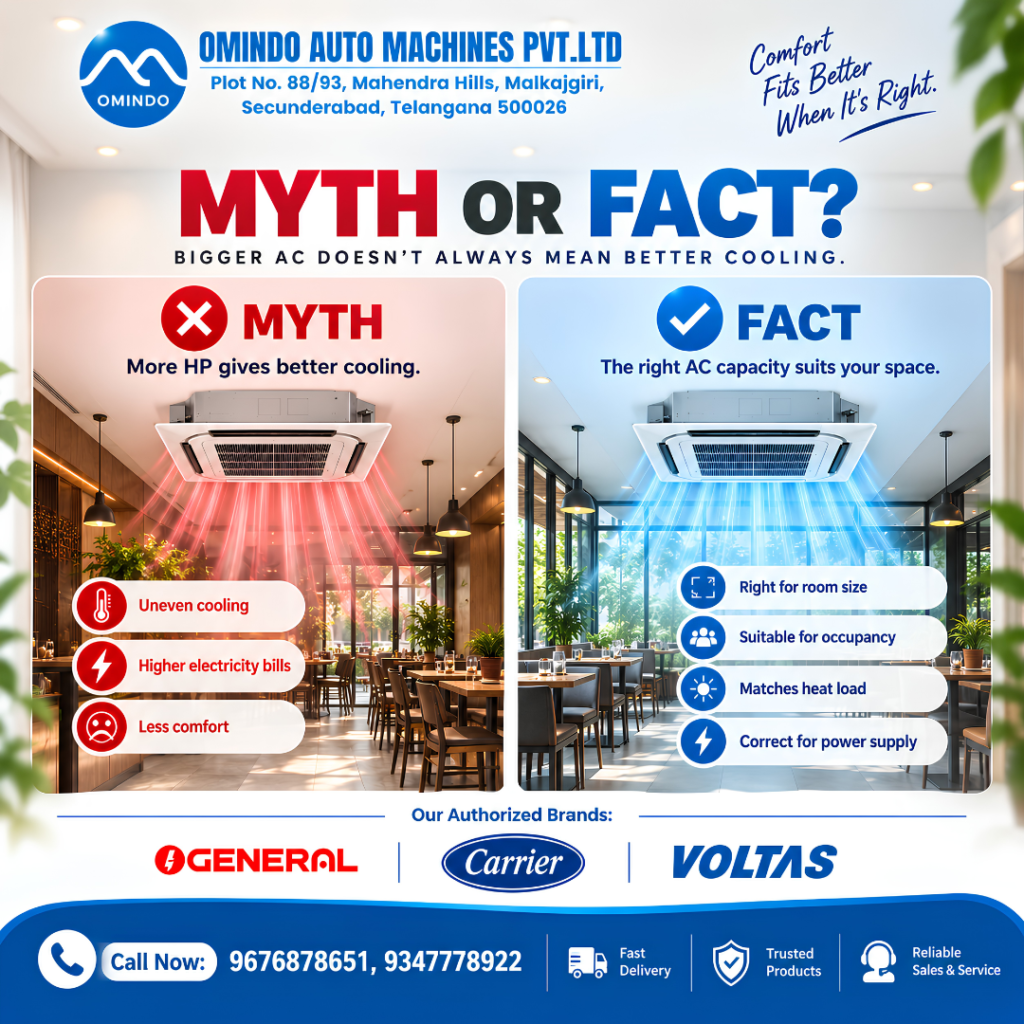
The idea that “bigger AC means better cooling” is a myth. The best AC is the one whose cooling capacity matches the room’s actual heat load.
Start with room size, but don’t stop there. Consider occupancy, sunlight, windows, ceiling height, floor level, appliances, insulation, outdoor temperature and usage pattern. A 1-ton AC may be perfectly suitable for one room, while another room of the same size may require a different capacity.
The right AC capacity can help you achieve better cooling, consistent comfort and more sensible energy use, while avoiding the problems associated with both undersized and oversized systems.
Before you buy your next AC, don’t ask only “Which AC is bigger?” Ask “Which AC is right for my space?”
Choose the Right Capacity. Choose the Right Comfort. Choose Omindo.
📍 Omindo Auto Machines Pvt. Ltd.
Mahendra Hills, Secunderabad, Telangana
📞 9676878651 | 9347778922
Our OGeneral Showroom at : 37-127/4/1, Neredmet X Rd, Gandhi Nagar, A. S. Rao Nagar, Secunderabad, Telangana 500056
Our Voltas Showroom at : Sh no 2/3/4, Rd Number 56, Ayyappa Society, Mega Hills, Madhapur, Hyderabad, Telangana 500081
Follow us for more at @omindoautomachines_hyd, fb: Omindo Auto Machines Pvt Ltd.
Our Products : Air Conditioners | Televisions | Refrigerators | Kitchen Hobs | Chimneys | Chest freezers | VRF