 OMINDO
Why Do Modern ACs Use R32 Refrigerant?
Why Do Modern ACs Use R32 Refrigerant?
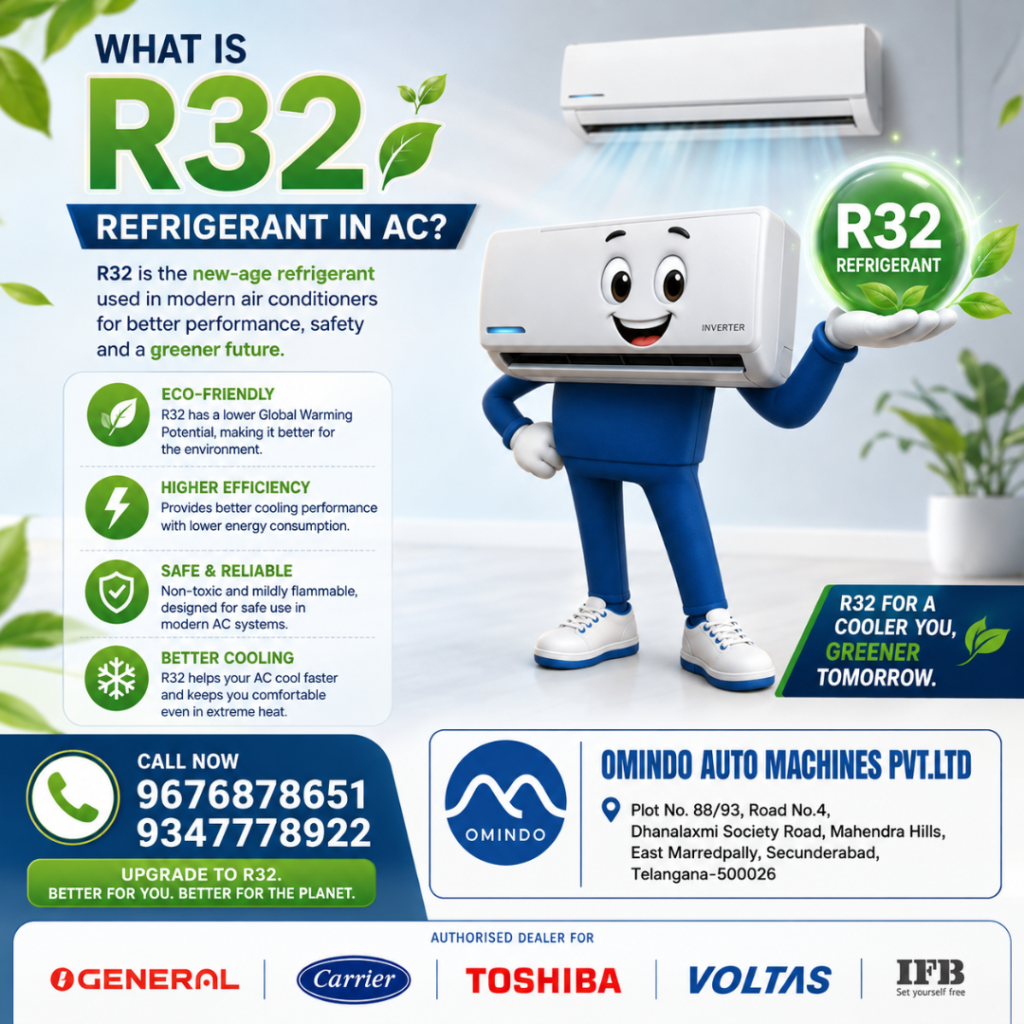
When you look at the specifications of a modern air conditioner, you may notice a term that appears again and again: R32 refrigerant.
But what exactly is R32? Why is it used in so many newer air conditioners? Is R32 better than older refrigerants? Is it safe? Does R32 make an AC cool faster or consume less electricity?
These are important questions because the refrigerant is one of the key components that allows an air conditioner to move heat from inside your room to the outdoors.
In this guide, we will explain R32 refrigerant in simple language, while also going deeper into its cooling performance, energy efficiency, environmental impact, safety classification, maintenance, and what consumers should know before buying an R32 AC.
What Is R32 Refrigerant in an AC?
R32 is a refrigerant used in air-conditioning and heat-pump systems. Its chemical name is difluoromethane (CH₂F₂). It belongs to the HFC family and is classified as A2L, meaning it has lower toxicity and mild flammability under the relevant refrigerant safety classification.
A refrigerant is the working fluid inside an AC that helps transfer heat.
The basic process is:
Indoor air → Heat absorbed by refrigerant → Refrigerant carries heat outside → Heat released outdoors → Cooled air returns indoors
So, R32 does not “create cold” by itself. Its job is to absorb and release heat efficiently as it circulates through the refrigeration system.
Why Is R32 Used in Modern Air Conditioners?
R32 has become an important refrigerant for modern AC systems because it offers a combination of:
- Lower Global Warming Potential
- Zero Ozone Depletion Potential
- Good heat-transfer characteristics
- High volumetric cooling capacity
- Potential for efficient system designs
- Single-component refrigerant composition
- Lower refrigerant charge in many system designs
These characteristics have made R32 attractive for residential and light-commercial air-conditioning applications. UNEP identifies HFC-32 as a lower-GWP option for small and medium-sized split air-conditioning systems.
How Does R32 Refrigerant Work in an AC?
To understand why refrigerant matters, it helps to understand the basic AC refrigeration cycle.
An air conditioner generally has four major refrigeration components:
- Compressor
- Condenser
- Expansion device
- Evaporator
R32 circulates through these components and changes pressure and state as it moves through the system.
Step 1: R32 Absorbs Heat Indoors
Inside the indoor unit, the refrigerant passes through the evaporator.
Warm indoor air moves across the evaporator coil.
The refrigerant absorbs heat from that air.
The result?
The air becomes cooler and is blown back into the room.
Step 2: The Compressor Raises Pressure
The refrigerant then travels to the compressor in the outdoor unit.
The compressor increases its pressure and temperature.
Step 3: Heat Is Released Outdoors
The hot, high-pressure refrigerant moves through the outdoor condenser coil.
The outdoor fan blows air across the coil, allowing heat to escape into the atmosphere.
Step 4: Refrigerant Pressure Drops
The refrigerant passes through an expansion device.
Its pressure and temperature drop, preparing it to absorb heat again.
The cycle repeats continuously while the AC is operating.
In One Line:
R32 continuously helps transfer heat from your room to the outside.
R32 vs R410A: Why Is R32 Considered Better?
One of the most important comparisons is R32 vs R410A.
R410A has been widely used in air-conditioning systems. Interestingly, R410A itself is a blend containing 50% R32 and 50% R125 by mass. R32, by contrast, is a single-component refrigerant.
Key Comparison
| Feature | R32 | R410A |
|---|---|---|
| Refrigerant Type | HFC | HFC blend |
| Ozone Depletion Potential | 0 | 0 |
| GWP* | 675 | 2,088 |
| Safety Classification | A2L | A1 |
| Composition | Single component | Blend |
| Common Application | Modern AC systems | Older/widely used AC systems |
*GWP values shown here use the commonly cited AR4 100-year values. Different regulatory frameworks can use updated GWP datasets, so published values may vary.
The most striking difference is Global Warming Potential.
R32 has a GWP of about 675, compared with about 2,088 for R410A in the cited datasets. That makes R32’s GWP roughly one-third of R410A’s.
What Is Global Warming Potential (GWP)?
GWP stands for Global Warming Potential.
It is a way of comparing how much heat a greenhouse gas can trap in the atmosphere relative to carbon dioxide over a specified time period.
A lower GWP generally means lower climate impact if the refrigerant is released, all else being equal.
For example:
- R32: GWP ≈ 675
- R410A: GWP ≈ 2,088
- R22: GWP ≈ 1,810
These figures are based on the commonly cited 100-year GWP values in the sources above.
Therefore, R32 represents a significant reduction in direct refrigerant climate impact compared with R410A.
Does R32 Damage the Ozone Layer?
R32 has zero Ozone Depletion Potential (ODP).
That means R32 does not contribute to ozone depletion in the way older ozone-depleting refrigerants did.
However, it is important to understand the distinction:
Zero ODP does not mean zero environmental impact.
R32 is still an HFC and has a Global Warming Potential. Its advantage is that its GWP is substantially lower than some commonly used older HFC refrigerants such as R410A.
Is R32 More Energy Efficient?
This question needs a little nuance.
R32 can support efficient AC system designs.
Its thermodynamic properties and heat-transfer characteristics make it suitable for efficient air-conditioning systems. Manufacturers can design systems around R32 to achieve strong cooling performance and energy efficiency.
However, you should not assume that every R32 AC automatically consumes less electricity than every R410A AC.
Actual electricity consumption depends on many factors, including:
- Compressor technology
- Inverter operation
- AC capacity
- ISEER/BEE rating
- Room size
- Outdoor temperature
- Temperature setting
- Insulation
- Installation quality
- Maintenance
- Usage hours
So, when buying an AC, look at the complete energy-efficiency specification, not just the refrigerant name.
Does R32 Make an AC Cool Faster?
R32 has good heat-transfer characteristics and high volumetric cooling capacity, which can help manufacturers design compact and efficient systems.
But saying “R32 automatically makes every AC cool faster” would be misleading.
Cooling speed depends on the entire AC system.
For example, a 1.5 Ton R32 inverter AC with an efficient compressor may provide excellent cooling, but room size, insulation, sunlight, outdoor temperature, airflow, and system design also have major effects.
Think of it this way:
Refrigerant + compressor + heat exchangers + airflow + controls = actual AC performance
R32 is one important piece of that puzzle.
Is R32 Refrigerant Safe?
Yes, R32 is used safely in appropriately designed and certified air-conditioning systems, but there is an important point consumers should know.
R32 is classified as A2L, which means it has lower toxicity and mild flammability. ASHRAE lists R32 as A2L, and Daikin’s technical information also identifies it as A2L.
Therefore, it is incorrect to describe R32 as completely non-flammable.
What Does A2L Mean?
The classification indicates:
- A → lower toxicity class
- 2L → mildly flammable with lower burning velocity
This does not mean an R32 AC is inherently dangerous during normal operation.
Modern R32 air conditioners are designed with appropriate system architecture, refrigerant charge limits, components, installation requirements, and safety measures.
Why Should R32 ACs Be Installed by Trained Technicians?
Because R32 is classified as A2L, installation, servicing, refrigerant recovery, and charging should be performed according to the manufacturer’s instructions and applicable safety requirements by appropriately trained technicians.
This is particularly important when:
- Installing a new AC
- Repairing refrigerant leaks
- Recovering refrigerant
- Charging refrigerant
- Replacing components
- Working on refrigerant piping
Manufacturers explicitly provide handling and installation requirements for R32 equipment.
Never Treat Refrigerant Charging as a DIY Job
The correct refrigerant must be used in the correct quantity and according to the equipment manufacturer’s specifications.
An R32 AC should not simply be charged with another refrigerant because it is available.
Refrigerants have different pressure, thermodynamic, and safety characteristics. Equipment is designed for a specific refrigerant.
Can R32 and R410A Be Mixed?
No.
An AC designed for R32 should use the refrigerant specified by its manufacturer.
Likewise, an R410A system should not be converted or topped up with R32 without an appropriately engineered and approved system conversion.
Refrigerant compatibility is not something that should be guessed based on similar-looking specifications.
Government guidance in Australia, for example, explicitly notes that equipment designed for R32 should not be charged with R410A.
Simple Rule:
Use the refrigerant specified on the AC nameplate and in the manufacturer’s service documentation.
What Happens If an R32 AC Has a Refrigerant Leak?
A refrigerant leak can cause:
- Reduced cooling
- Longer compressor operation
- Poor energy efficiency
- Ice formation on the indoor coil
- Unusual operating behavior
- Potential compressor damage if the system continues operating under abnormal conditions
If you suspect a leak, don’t simply ask for a refrigerant “top-up.”
A proper service process should identify the cause.
A professional technician should:
- Inspect the system.
- Locate the leak.
- Repair the leak.
- Perform the required pressure/leak checks.
- Evacuate the system as specified.
- Charge the correct refrigerant quantity according to the manufacturer’s instructions.
- Test the AC.
A refrigerant top-up without fixing the leak is only a temporary solution.
Does R32 Reduce Electricity Bills?
R32 itself does not guarantee a lower electricity bill.
However, R32’s properties can support efficient system designs, and manufacturers can combine R32 with modern inverter compressors and efficient heat exchangers to produce highly efficient air conditioners.
Your actual electricity bill depends on the complete system and how you use it.
For lower AC electricity consumption:
- Choose the correct tonnage.
- Prefer a high-efficiency inverter AC.
- Check the BEE star rating and ISEER for Indian models.
- Set a reasonable temperature.
- Keep filters clean.
- Maintain the outdoor unit.
- Ensure correct installation.
- Keep doors and windows closed while cooling.
R32 and the Environment
One of the biggest reasons R32 has gained attention is its lower GWP compared with R410A.
R32’s Main Environmental Advantages
1. Zero ODP
R32 has zero ozone depletion potential.
2. Lower GWP
Its GWP of approximately 675 is significantly lower than R410A’s approximately 2,088 in the cited AR4-based data.
3. Potentially Smaller Refrigerant Charge
R32’s high volumetric cooling capacity can allow systems to use less refrigerant by mass in certain designs.
4. Easier Recovery and Recycling as a Single Component
Unlike blended refrigerants, R32 is a single-component refrigerant. This can simplify recovery and reuse compared with mixtures, provided proper procedures are followed.
Is R32 a “Green Refrigerant”?
It is better to be precise.
R32 is a lower-GWP refrigerant compared with R410A, and it has zero ODP. That makes it a more environmentally favorable option in many AC applications.
But calling it completely “green” can be misleading because:
- R32 is still an HFC.
- It still has a GWP.
- Refrigerant leakage matters.
- Electricity consumption during the AC’s lifetime also contributes to environmental impact.
- Proper recovery and disposal are important.
So the better description is:
R32 is a lower-GWP refrigerant that can help reduce the environmental impact of air-conditioning systems compared with higher-GWP alternatives such as R410A.
Why Is R32 Becoming Common in Modern ACs?
There isn’t one single reason.
R32 provides a combination of characteristics that make it attractive for modern air-conditioning equipment:
🌱 Lower Environmental Impact
Lower GWP compared with R410A.
⚡ Good Efficiency Potential
Good heat-transfer and thermodynamic characteristics support efficient system designs.
❄️ Strong Cooling Performance
R32 is suitable for systems designed to deliver effective cooling.
🔧 Single-Component Refrigerant
It is not a blend like R410A.
📦 High Volumetric Capacity
Systems can potentially achieve a given cooling capacity with a smaller refrigerant charge.
🏠 Suitable for Residential ACs
R32 has become particularly important in smaller split AC systems. UNEP identifies HFC-32 among lower-GWP options for small and medium-sized split air-conditioning applications.
R32 vs R22 vs R410A
Here’s a simple overview:
| Feature | R22 | R410A | R32 |
|---|---|---|---|
| Type | HCFC | HFC blend | HFC |
| ODP | 0.05 | 0 | 0 |
| GWP* | 1,810 | 2,088 | 675 |
| Composition | Single component | Blend | Single component |
| Safety Class | A1 | A1 | A2L |
| Modern Use | Being phased out/restricted in many contexts | Older/current systems | Widely used in newer systems |
*Values shown are commonly cited 100-year GWP values from the referenced datasets.
This table demonstrates why R32 has become attractive as the industry moves toward lower-GWP refrigerants.
Is an R32 AC Better Than an R410A AC?
For a new AC purchase, R32 can be an attractive choice because of its lower GWP and suitability for efficient modern system designs.
However, refrigerant type should not be the only purchasing factor.
Compare:
- Cooling capacity
- BEE star rating
- ISEER
- Inverter technology
- Annual energy consumption
- Noise level
- Warranty
- Installation quality
- Service network
- Spare-parts availability
- Brand reliability
- Actual room requirements
A well-designed, properly sized, properly installed AC is more important than simply choosing an AC because it says “R32” on the specification sheet.
Frequently Asked Questions About R32 Refrigerant
What is R32 refrigerant in AC?
R32 is difluoromethane, an HFC refrigerant used in modern air-conditioning systems to transfer heat between the indoor and outdoor units. It has zero ODP and a lower GWP than R410A.
Is R32 refrigerant better than R410A?
R32 has a much lower GWP than R410A and can support efficient AC system designs. However, overall AC performance depends on the complete system, not just the refrigerant.
Is R32 refrigerant safe?
R32 is widely used in properly designed AC systems. It is classified as A2L, meaning mildly flammable, so appropriate installation and servicing procedures are important.
Is R32 refrigerant flammable?
R32 is mildly flammable and classified A2L. It should therefore be handled by appropriately trained technicians using the manufacturer’s specified procedures.
Does R32 cool better?
R32 has good heat-transfer characteristics and can support efficient cooling-system designs. However, cooling performance depends on the entire AC system, including compressor, heat exchangers, airflow, capacity, and installation.
Does R32 save electricity?
R32 can support energy-efficient AC designs, but refrigerant type alone does not determine electricity consumption. Check the AC’s efficiency rating, ISEER, capacity, and annual energy consumption as well.
Can R32 be used in an R410A AC?
Do not substitute R32 for R410A unless the equipment has specifically been engineered, approved, and converted for it. Always use the refrigerant specified by the manufacturer.
How often should R32 refrigerant be refilled?
A properly sealed AC should not need routine refrigerant refilling simply because time has passed. If refrigerant is low, there may be a leak or another system problem that needs to be investigated.
Is R32 environmentally friendly?
R32 has zero ODP and a lower GWP than R410A, making it a lower-impact option compared with higher-GWP refrigerants. However, it is not impact-free.
What Should You Check When Buying an R32 AC?
Don’t buy an AC solely because it uses R32.
Use this checklist:
✅ 1. Correct Tonnage
Choose the AC capacity according to your room size and heat load.
✅ 2. BEE Star Rating
For Indian ACs, check the energy label and efficiency information.
✅ 3. ISEER
Compare the seasonal efficiency of different models.
✅ 4. Inverter Technology
An inverter compressor can adjust output according to the cooling requirement.
✅ 5. Annual Energy Consumption
This can give you a better idea of potential running costs.
✅ 6. Installation Quality
Correct copper piping, drainage, electrical connections, evacuation, and refrigerant handling all matter.
✅ 7. After-Sales Support
A good service network is essential for long-term AC ownership.
✅ 8. Genuine Refrigerant and Parts
Use the manufacturer’s specified refrigerant and genuine components.
Final Verdict: Why Do Modern ACs Use R32 Refrigerant?
R32 has become an important refrigerant for modern air conditioners because it combines good cooling-system characteristics with a significantly lower GWP than R410A.
Its key advantages include:
- Zero ozone depletion potential
- Lower global warming potential
- Good heat-transfer characteristics
- High volumetric cooling capacity
- Potential for efficient AC system designs
- Single-component refrigerant
- Suitability for many modern residential AC applications
At the same time, R32 is A2L mildly flammable, so professional installation and servicing are important.
The simplest way to remember it:
R32 isn’t simply “a gas that makes an AC colder.”
It is the working fluid that carries heat through the AC refrigeration cycle, and its physical properties influence how efficiently manufacturers can design the system.
If you’re buying a new AC, look beyond the refrigerant name. Consider R32 + correct tonnage + inverter technology + BEE rating + ISEER + installation quality + after-sales service.
That combination is what ultimately determines whether your AC delivers efficient, reliable, and comfortable cooling.
Our OGeneral Showroom at : 37-127/4/1, Neredmet X Rd, Gandhi Nagar, A. S. Rao Nagar, Secunderabad, Telangana 500056
Our Voltas Showroom at : Sh no 2/3/4, Rd Number 56, Ayyappa Society, Mega Hills, Madhapur, Hyderabad, Telangana 500081
Follow us for more at @omindoautomachines_hyd, fb: Omindo Auto Machines Pvt Ltd.
Our Products : Air Conditioners | Televisions | Refrigerators | Kitchen Hobs | Chimneys | Chest freezers | VRF Services