Air Conditioners

How to Save Electricity While Using an Air Conditioner

How to Save Electricity While Using an Air Conditioner

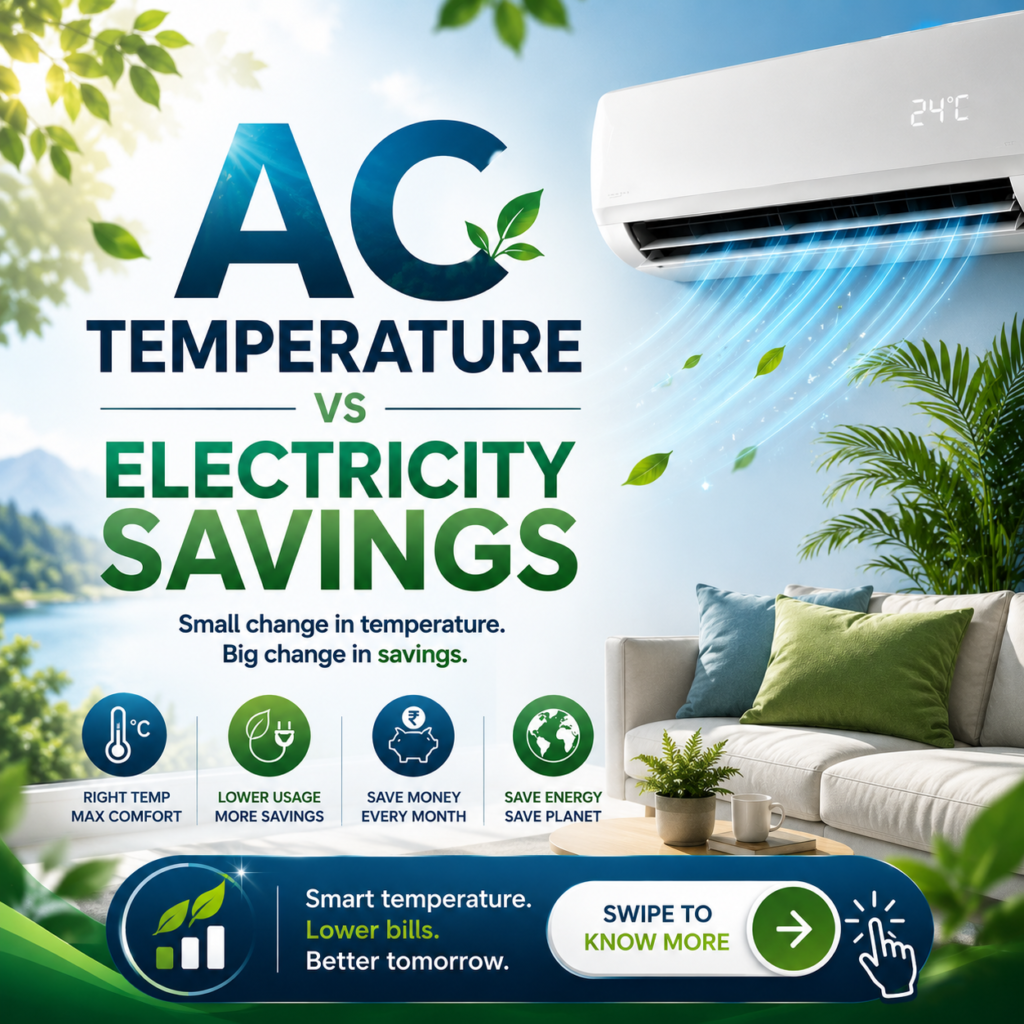
How to Save Electricity While Using an Air Conditioner Using an air conditioner during hot weather can significantly increase household or business electricity consumption, especially when the AC runs for long hours. However, you do not always need to sacrifice comfort to reduce your electricity bill. The right AC temperature setting, operating habits, regular maintenance, and energy-efficient practices can help reduce unnecessary power consumption while keeping your space comfortably cool. If you are wondering how to save electricity while using an air conditioner, the key is to make your AC work efficiently rather than simply running it at the lowest possible temperature. 1. Set Your AC Temperature Around 24–26°C One of the simplest ways to improve AC energy efficiency is to avoid unnecessarily low temperature settings. Many people set their AC to 16°C, 18°C, or 20°C expecting the room to cool faster. However, setting a lower temperature does not necessarily make the AC cool the room faster. Instead, the air conditioner may need to operate for longer to reach the lower target temperature. For normal indoor comfort, a setting around 24–26°C can provide a practical balance between cooling and electricity consumption.   The ideal temperature can vary depending on outdoor temperature, humidity, room occupancy, insulation, and individual comfort preferences. The important point is to avoid extreme cooling when it is not necessary. 2. Avoid Setting the AC to 16°C Setting your air conditioner to 16°C does not mean the room will cool twice as quickly compared with 24°C. The AC’s cooling capacity is determined by factors such as its tonnage, compressor capacity, room size, insulation, and outdoor conditions. The thermostat setting mainly determines the temperature the system attempts to maintain. A very low temperature setting can result in longer compressor operation and higher electricity consumption. Instead of immediately selecting the lowest temperature, start around 24–26°C and adjust gradually according to your comfort. 3. Use Sleep Mode at Night If your AC has a Sleep Mode, consider using it while sleeping. Sleep Mode is designed to adjust the cooling operation over time, depending on the model. Many air conditioners gradually modify the temperature or compressor operation during the night. This can provide a more comfortable sleeping environment while potentially reducing unnecessary cooling and electricity consumption. Always check your specific AC’s manual because Sleep Mode functions differ between manufacturers and models. 4. Keep Doors and Windows Closed An AC cannot efficiently cool a room if cooled air is continuously escaping. When the AC is running: Keep doors and windows properly closed. Minimize unnecessary movement between air-conditioned and non-air-conditioned areas. Close gaps around doors and windows where practical. Avoid leaving doors open for long periods. Reducing air leakage helps the AC maintain the desired indoor temperature with less unnecessary cooling effort. 5. Reduce Direct Heat From Sunlight Direct sunlight can significantly increase the heat entering a room. During hot daytime hours, curtains, blinds, shades, or suitable window treatments can help reduce solar heat entering through windows. This is particularly useful for rooms with large windows or windows facing strong afternoon sunlight. Less heat entering the room means the air conditioner has less heat to remove. 6. Clean AC Filters Regularly A dirty air filter can restrict airflow and reduce cooling efficiency. When airflow is restricted, the AC may need to operate for longer periods to provide the desired cooling. Dust accumulation can also affect indoor air quality and overall system performance. Clean the filters at suitable intervals based on usage, indoor dust levels, and the manufacturer’s recommendations. Homes, offices, shops, and commercial spaces with higher dust levels may require more frequent attention. 7. Schedule Regular AC Maintenance AC efficiency is not only about temperature settings. The condition of the entire system matters. Professional AC maintenance and servicing can help identify issues such as: Dirty filters and coils Reduced airflow Blocked drainage Refrigerant-related problems Electrical issues Fan or blower problems Unusual compressor operation Poor cooling performance Regular maintenance can help keep the system operating properly and may prevent small problems from developing into expensive repairs. 8. Choose the Right AC Capacity An incorrectly sized air conditioner can affect both comfort and electricity consumption. An AC that is too small for the room may have to operate for extended periods to reach the desired temperature. An oversized system may cool the space quickly but may not always provide ideal humidity control or efficient operation. Before purchasing an AC, consider: Room size Ceiling height Number of occupants Window area Sun exposure Insulation Floor level Heat-producing appliances Type of space Local climate For commercial areas, offices, retail stores, restaurants, and larger spaces, professional cooling-load assessment can be especially important. 9. Consider an Inverter AC If you use your air conditioner for several hours every day, an inverter AC can be worth considering. Unlike conventional fixed-speed systems that primarily operate by switching the compressor on and off, inverter technology can vary compressor speed according to cooling demand. Once the desired temperature is approached, an inverter AC can modulate its operation rather than continuously operating at full capacity. Actual electricity savings depend on the model, usage pattern, temperature setting, room conditions, installation quality, and outdoor temperature. Therefore, an inverter AC should not be viewed as an automatic guarantee of a specific percentage of savings. 10. Select a Higher Energy-Efficiency Rating When purchasing a new air conditioner, compare its energy-efficiency information rather than looking only at the purchase price. In India, consumers can compare applicable BEE star ratings and efficiency information when selecting an AC. A more efficient AC can be particularly beneficial when the appliance is used for many hours each day. However, remember that the actual electricity bill depends on several factors, including: AC capacity × operating hours × cooling load × efficiency × usage conditions. Therefore, choosing an efficient model and using it correctly should go together. 11. Use Fans Along With the AC A ceiling fan or suitable air circulator can improve the distribution of cool air throughout a room. Because moving air can improve

How to Save Electricity While Using an Air Conditioner Read More »

planning-for-cassette-ac

4 Essential Things to Know Before Installing a Cassette AC

4 Essential Things to Know Before Installing a Cassette AC A cassette air conditioner can be an excellent cooling solution for offices, showrooms, restaurants, retail stores, conference rooms, and other commercial spaces. Unlike a conventional wall-mounted split AC, a cassette AC is installed into or around the false ceiling and distributes cool air across the room, making it suitable for larger spaces that require more uniform airflow. However, choosing the right capacity is only one part of a successful cassette AC installation. False ceiling clearance, drainage, indoor unit placement, refrigerant piping, and electrical requirements all need to be considered before installation. Poor planning can result in drainage problems, uneven cooling, excessive noise, difficult maintenance, or unnecessary installation costs. Here are four important things you should check before installing a cassette AC. 1. Check False Ceiling Clearance One of the first things to consider when installing a cassette air conditioner is the available space above the false ceiling. The indoor cassette unit is positioned above the visible ceiling panel, while the decorative panel remains visible from inside the room. Therefore, there must be sufficient space above the false ceiling to accommodate the indoor unit, refrigerant piping, drain piping, electrical connections, and other installation requirements. Why is false ceiling clearance important? Insufficient space can make installation difficult and may cause problems with: Refrigerant pipe routing Condensate drain piping Electrical connections Drain pump operation Air circulation around the indoor unit Future servicing and maintenance Before finalizing the false ceiling design, check the installation manual and dimensional requirements of the specific cassette AC model. Do not assume that every cassette AC has the same dimensions or clearance requirements. Tip for new installations If you are constructing a new false ceiling, involve the AC installation team before the ceiling framework is finalized. This allows the AC location, service access, piping route, and ceiling opening to be planned properly. 2. Plan Condensate Drainage Properly A cassette AC removes moisture from indoor air during cooling. This moisture collects as condensate and must be safely discharged through the drain system. Many modern cassette AC units include a built-in drain pump, particularly where gravity-based drainage cannot easily be achieved. However, having a drain pump does not mean that the drainage system can be installed without proper planning. Why is proper drainage important? Incorrect drainage can lead to: Water leakage from the indoor unit Water dripping through the false ceiling Dampness and ceiling damage Unpleasant odors Drain blockages Frequent maintenance issues Where the installation design permits, the drain pipe should be routed with the appropriate slope for reliable water flow. If gravity drainage is not possible, the unit’s specified drain pump arrangement and piping requirements should be followed. Important installation check The drain pipe diameter, maximum lift, pipe routing, slope requirements, and drain pump limitations can vary between models. Therefore, always follow the manufacturer’s installation specifications rather than applying one standard measurement to every cassette AC. A professional installer should also test the drainage system before closing the false ceiling. 3. Position the Cassette AC at the Center of the Room One of the major advantages of a ceiling cassette AC is its ability to distribute air across multiple directions. For many 4-way cassette AC models, positioning the indoor unit close to the center of the conditioned area can help achieve more uniform airflow. Why does placement matter? If a cassette AC is installed too close to a wall or in an unsuitable corner, airflow distribution may become less balanced. This can result in: Uneven cooling Hot spots within the room Reduced comfort Airflow reaching walls or obstacles too quickly Less effective coverage of the usable space A centrally positioned cassette can generally provide better coverage because the air can be distributed across the room. But the center is not always the answer Room layout matters. Before deciding the exact location, consider: Room dimensions Seating arrangement Partitions Lighting fixtures Ceiling beams Fans Electrical fixtures Glass walls and heat-generating areas Doors and frequently opened entrances Multiple cassette units in larger spaces For larger commercial areas, multiple cassette AC units may be required instead of relying on a single high-capacity unit. The goal should be proper airflow distribution across the occupied area, not simply placing the AC at the geometric center of the room. 4. Check Refrigerant Piping and Electrical Requirements Another critical part of cassette AC installation is correctly planning the refrigerant piping and electrical system. The refrigerant pipe connects the indoor and outdoor units. Pipe diameter, maximum pipe length, vertical height difference, insulation, and additional refrigerant requirements depend on the particular AC model. Some cassette AC systems use R32 refrigerant, while other models may use different refrigerants. Therefore, never select or charge refrigerant based only on the general category of the AC. Why is refrigerant piping important? Incorrect refrigerant piping can affect: Cooling performance Energy efficiency Compressor operation System reliability Long-term maintenance The installer should follow the manufacturer’s specified pipe sizes, maximum permissible lengths, height differences, insulation requirements, and refrigerant charging procedures. Electrical sizing is equally important Cassette ACs can require substantial electrical power depending on their capacity and configuration. Before installation, check: Rated voltage Phase requirement Rated current Maximum current Recommended cable size Recommended breaker/protection Earthing requirements Dedicated power supply requirements The electrical installation should be designed according to the manufacturer’s specifications and applicable electrical safety requirements. Do not select cable or breaker size based only on the AC tonnage. The actual electrical specifications of the selected model should be used. Other Things to Check Before Installing a Cassette AC The four points above are essential, but a proper site assessment should go further. Calculate the Required AC Capacity Choosing an AC based only on room size can sometimes lead to an incorrectly sized system. Cooling requirements can be affected by: Room dimensions Ceiling height Number of occupants Number and size of windows Direct sunlight Glass surfaces Computers and electrical equipment Lighting load Door openings Building insulation Type of commercial activity For offices, showrooms, restaurants, and other commercial

4 Essential Things to Know Before Installing a Cassette AC Read More »

Why Do Modern ACs Use R32 Refrigerant?

Why Do Modern ACs Use R32 Refrigerant?

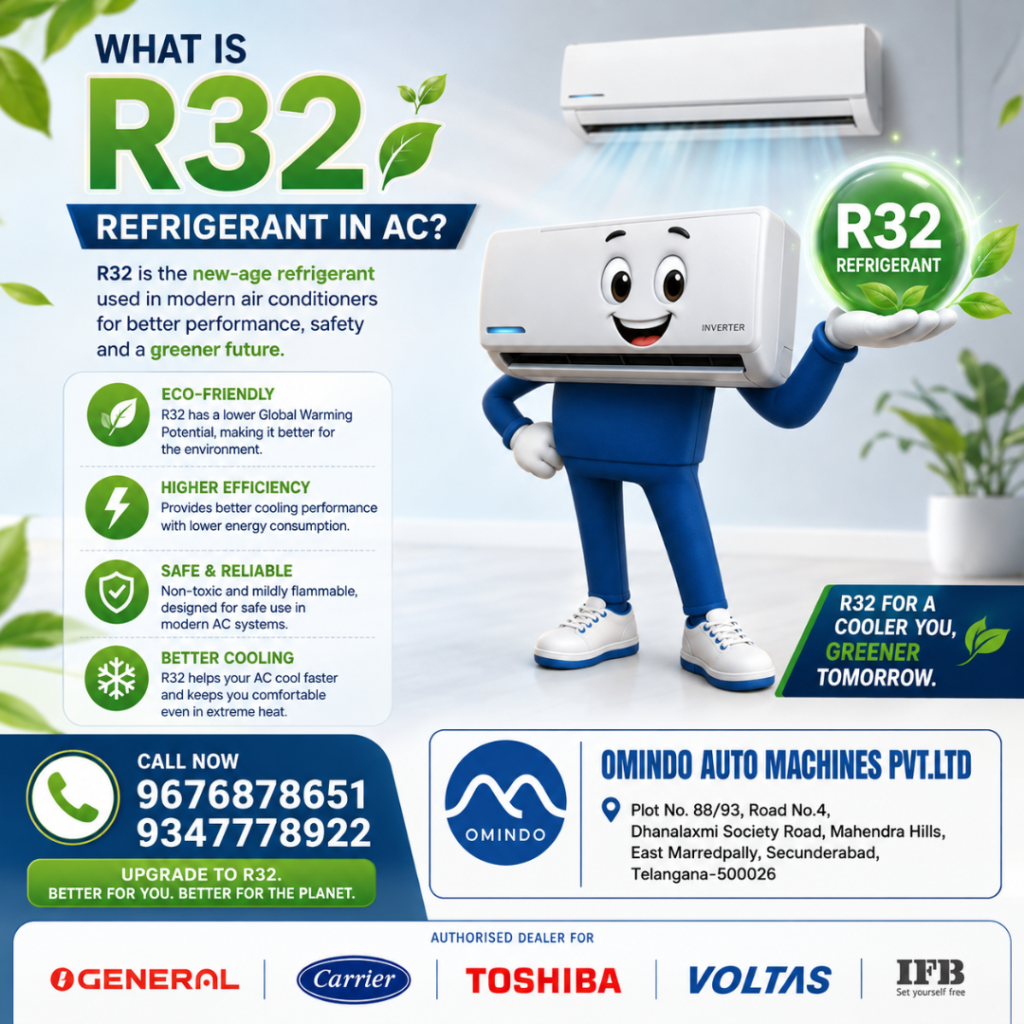
Why Do Modern ACs Use R32 Refrigerant? When you look at the specifications of a modern air conditioner, you may notice a term that appears again and again: R32 refrigerant. But what exactly is R32? Why is it used in so many newer air conditioners? Is R32 better than older refrigerants? Is it safe? Does R32 make an AC cool faster or consume less electricity? These are important questions because the refrigerant is one of the key components that allows an air conditioner to move heat from inside your room to the outdoors. In this guide, we will explain R32 refrigerant in simple language, while also going deeper into its cooling performance, energy efficiency, environmental impact, safety classification, maintenance, and what consumers should know before buying an R32 AC. What Is R32 Refrigerant in an AC? R32 is a refrigerant used in air-conditioning and heat-pump systems. Its chemical name is difluoromethane (CH₂F₂). It belongs to the HFC family and is classified as A2L, meaning it has lower toxicity and mild flammability under the relevant refrigerant safety classification. A refrigerant is the working fluid inside an AC that helps transfer heat. The basic process is: Indoor air → Heat absorbed by refrigerant → Refrigerant carries heat outside → Heat released outdoors → Cooled air returns indoors So, R32 does not “create cold” by itself. Its job is to absorb and release heat efficiently as it circulates through the refrigeration system. Why Is R32 Used in Modern Air Conditioners? R32 has become an important refrigerant for modern AC systems because it offers a combination of: Lower Global Warming Potential Zero Ozone Depletion Potential Good heat-transfer characteristics High volumetric cooling capacity Potential for efficient system designs Single-component refrigerant composition Lower refrigerant charge in many system designs These characteristics have made R32 attractive for residential and light-commercial air-conditioning applications. UNEP identifies HFC-32 as a lower-GWP option for small and medium-sized split air-conditioning systems. How Does R32 Refrigerant Work in an AC? To understand why refrigerant matters, it helps to understand the basic AC refrigeration cycle. An air conditioner generally has four major refrigeration components: Compressor Condenser Expansion device Evaporator R32 circulates through these components and changes pressure and state as it moves through the system. Step 1: R32 Absorbs Heat Indoors Inside the indoor unit, the refrigerant passes through the evaporator. Warm indoor air moves across the evaporator coil. The refrigerant absorbs heat from that air. The result? The air becomes cooler and is blown back into the room. Step 2: The Compressor Raises Pressure The refrigerant then travels to the compressor in the outdoor unit. The compressor increases its pressure and temperature. Step 3: Heat Is Released Outdoors The hot, high-pressure refrigerant moves through the outdoor condenser coil. The outdoor fan blows air across the coil, allowing heat to escape into the atmosphere. Step 4: Refrigerant Pressure Drops The refrigerant passes through an expansion device. Its pressure and temperature drop, preparing it to absorb heat again. The cycle repeats continuously while the AC is operating. In One Line: R32 continuously helps transfer heat from your room to the outside. R32 vs R410A: Why Is R32 Considered Better? One of the most important comparisons is R32 vs R410A. R410A has been widely used in air-conditioning systems. Interestingly, R410A itself is a blend containing 50% R32 and 50% R125 by mass. R32, by contrast, is a single-component refrigerant. Key Comparison Feature R32 R410A Refrigerant Type HFC HFC blend Ozone Depletion Potential 0 0 GWP* 675 2,088 Safety Classification A2L A1 Composition Single component Blend Common Application Modern AC systems Older/widely used AC systems *GWP values shown here use the commonly cited AR4 100-year values. Different regulatory frameworks can use updated GWP datasets, so published values may vary. The most striking difference is Global Warming Potential. R32 has a GWP of about 675, compared with about 2,088 for R410A in the cited datasets. That makes R32’s GWP roughly one-third of R410A’s. What Is Global Warming Potential (GWP)? GWP stands for Global Warming Potential. It is a way of comparing how much heat a greenhouse gas can trap in the atmosphere relative to carbon dioxide over a specified time period. A lower GWP generally means lower climate impact if the refrigerant is released, all else being equal. For example: R32: GWP ≈ 675 R410A: GWP ≈ 2,088 R22: GWP ≈ 1,810 These figures are based on the commonly cited 100-year GWP values in the sources above. Therefore, R32 represents a significant reduction in direct refrigerant climate impact compared with R410A. Does R32 Damage the Ozone Layer? R32 has zero Ozone Depletion Potential (ODP). That means R32 does not contribute to ozone depletion in the way older ozone-depleting refrigerants did. However, it is important to understand the distinction: Zero ODP does not mean zero environmental impact. R32 is still an HFC and has a Global Warming Potential. Its advantage is that its GWP is substantially lower than some commonly used older HFC refrigerants such as R410A. Is R32 More Energy Efficient? This question needs a little nuance. R32 can support efficient AC system designs. Its thermodynamic properties and heat-transfer characteristics make it suitable for efficient air-conditioning systems. Manufacturers can design systems around R32 to achieve strong cooling performance and energy efficiency. However, you should not assume that every R32 AC automatically consumes less electricity than every R410A AC. Actual electricity consumption depends on many factors, including: Compressor technology Inverter operation AC capacity ISEER/BEE rating Room size Outdoor temperature Temperature setting Insulation Installation quality Maintenance Usage hours So, when buying an AC, look at the complete energy-efficiency specification, not just the refrigerant name. Does R32 Make an AC Cool Faster? R32 has good heat-transfer characteristics and high volumetric cooling capacity, which can help manufacturers design compact and efficient systems. But saying “R32 automatically makes every AC cool faster” would be misleading. Cooling speed depends on the entire AC system. For example, a 1.5 Ton R32 inverter AC with an efficient compressor may provide excellent cooling, but room size,

Why Do Modern ACs Use R32 Refrigerant? Read More »

SEER vs EER: Which AC Rating Is Better?

SEER vs EER: Which AC Rating Is Better?

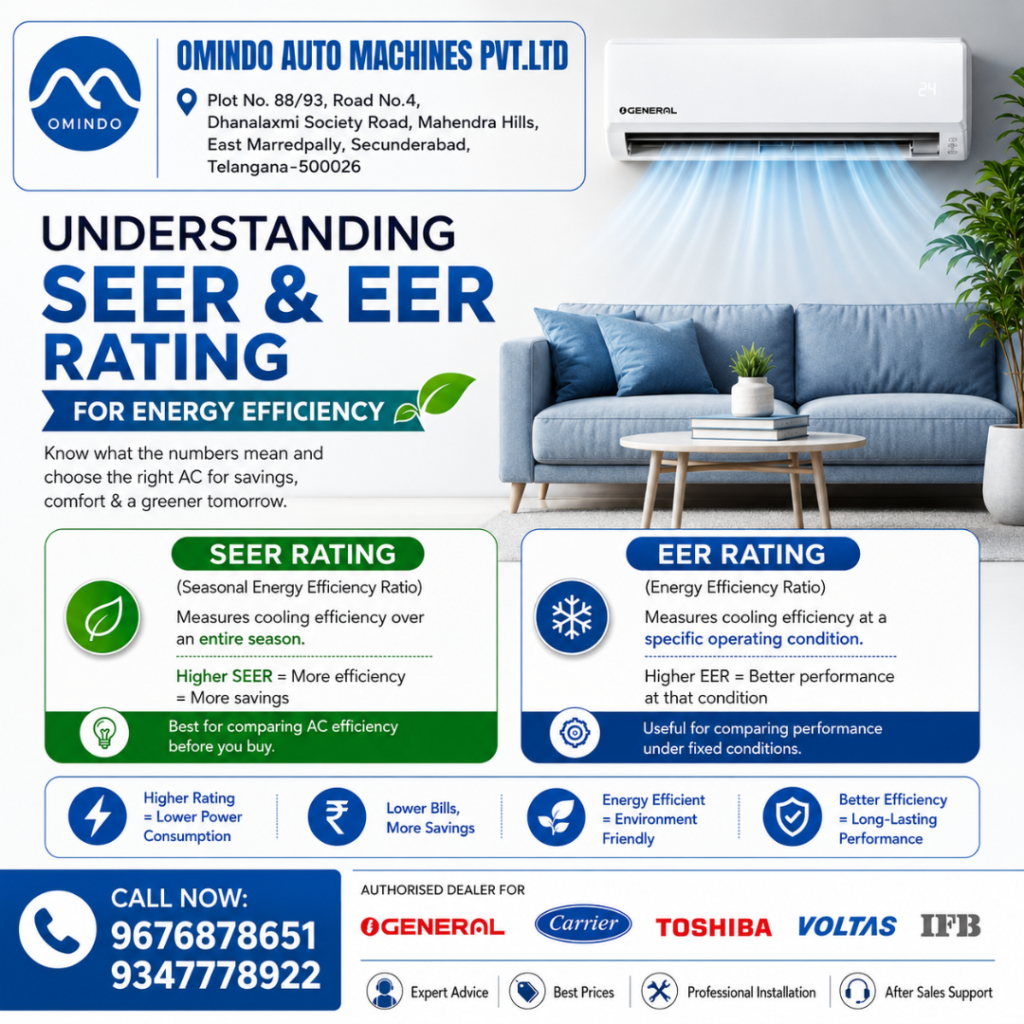
SEER vs EER: Which AC Rating Is Better? When buying an air conditioner, energy efficiency is one of the most important factors to consider. Two terms you may come across are SEER and EER. Both ratings help you understand how efficiently an AC uses electricity to provide cooling, but they measure performance in different ways. So, SEER vs EER: Which AC rating is better? The simple answer is: SEER is more useful for understanding seasonal energy efficiency, while EER is useful for comparing AC performance under a specific operating condition. For buyers in India, it is also important to understand ISEER and the BEE star rating, which are commonly used on AC energy labels. Let’s break it down in simple language. What Is EER in an Air Conditioner? EER stands for Energy Efficiency Ratio. It measures how efficiently an air conditioner provides cooling under a specific set of operating conditions. In simple terms: EER tells you how efficiently an AC performs at a particular condition. A higher EER generally means the AC can provide more cooling for the electricity it consumes under that test condition. EER Formula EER = Cooling Capacity (BTU/hour) ÷ Power Consumption (Watts) For example, if an AC provides 12,000 BTU/hour of cooling while consuming 1,000 watts: EER = 12 This means the AC provides 12 BTU of cooling for every watt of electricity consumed under the specified test condition. What Is SEER in an Air Conditioner? SEER stands for Seasonal Energy Efficiency Ratio. Unlike EER, which evaluates performance at a specific condition, SEER considers AC efficiency across a range of conditions over a cooling season. This makes SEER particularly useful for understanding how an air conditioner may perform as outdoor temperatures and operating conditions change. In Simple Words EER = Efficiency at a specific operating condition SEER = Efficiency across a cooling season A higher SEER generally indicates better seasonal energy efficiency. SEER vs EER: What Is the Difference? Feature EER SEER Full Form Energy Efficiency Ratio Seasonal Energy Efficiency Ratio Measures Efficiency at a specific condition Seasonal cooling efficiency Operating Conditions Fixed test condition Multiple/seasonal conditions Useful For Specific-condition comparison Overall seasonal efficiency Higher Rating Generally better efficiency Generally better seasonal efficiency Which Is Better: SEER or EER? There isn’t a simple “SEER is always better than EER” answer because they measure different aspects of AC efficiency. Choose SEER When You Want to Understand: Seasonal energy efficiency Long-term cooling performance Expected efficiency across changing outdoor temperatures How efficiently an AC operates over a cooling season Use EER When You Want to Compare: Performance under a particular condition Cooling output against electricity consumption AC efficiency at a defined test temperature Therefore, SEER is generally more useful for understanding seasonal efficiency, while EER is useful for specific-condition performance comparisons. Why Does AC Energy Efficiency Matter? An air conditioner can be one of the larger electricity-consuming appliances in a home, particularly during hot weather. Choosing an efficient AC can help you achieve: Lower Electricity Consumption A more efficient air conditioner can provide the required cooling while using less electricity. Lower Cooling Costs Lower electricity consumption can help reduce your monthly power bill, especially when the AC is used for several hours every day. Better Long-Term Value An efficient AC may cost more initially, but lower operating costs can make it a better investment over its lifetime. More Environment-Friendly Cooling Using less electricity can also reduce the environmental impact associated with energy consumption. What Is ISEER? If you are buying an AC in India, there is another important term you should know: ISEER = Indian Seasonal Energy Efficiency Ratio. ISEER is designed to evaluate the seasonal efficiency of air conditioners under Indian climatic conditions. This is particularly relevant because India’s weather varies significantly across regions and seasons. For Indian consumers, the BEE energy label and ISEER value are important indicators to check when comparing air conditioners. SEER vs EER vs ISEER These three terms can be confusing, so here’s a simple comparison: Rating What It Tells You EER AC efficiency under a specific operating condition SEER Seasonal cooling efficiency ISEER Seasonal efficiency based on Indian conditions If you’re shopping for an AC in India, don’t look only at SEER or EER. Check the BEE star rating and ISEER value on the energy label as well. Is a Higher AC Energy Rating Always Better? Generally, a higher efficiency rating indicates better energy performance, but you should not choose an AC based on the rating alone. Consider these factors together: 1. AC Capacity Choose the correct capacity for your room. For example: Small room → 1 Ton may be suitable Medium room → 1.5 Ton may be suitable Large room → 2 Ton may be suitable The exact requirement depends on room size, sunlight, insulation, ceiling height, occupancy, and other heat-load factors. 2. Energy Rating Compare the BEE star rating and ISEER value when purchasing an AC in India. 3. Inverter Technology An inverter AC can adjust compressor speed according to the cooling requirement, helping improve efficiency during variable-load operation. 4. Usage Hours If you use your AC for many hours every day, energy efficiency becomes even more important. 5. Room Conditions A room with direct sunlight, poor insulation, large windows, or many occupants may require more cooling capacity. How to Choose an Energy-Efficient AC If your goal is to reduce electricity consumption, follow these steps. Step 1: Choose the Correct AC Capacity Don’t simply buy the largest AC available. An oversized or undersized AC may not provide the best combination of comfort and efficiency. Step 2: Check the BEE Star Rating For ACs sold in India, check the BEE energy label before purchasing. A higher star rating generally indicates better energy efficiency. Step 3: Compare ISEER Values When comparing two inverter ACs, look at their ISEER values along with their star ratings. A higher ISEER generally indicates better seasonal efficiency. Step 4: Consider Your Daily Usage If your AC operates for only a short period each day, the difference

SEER vs EER: Which AC Rating Is Better? Read More »

what_does_tonnage_actually_mean_in_an_ac.png

How to Choose the Right AC Tonnage for Your Home

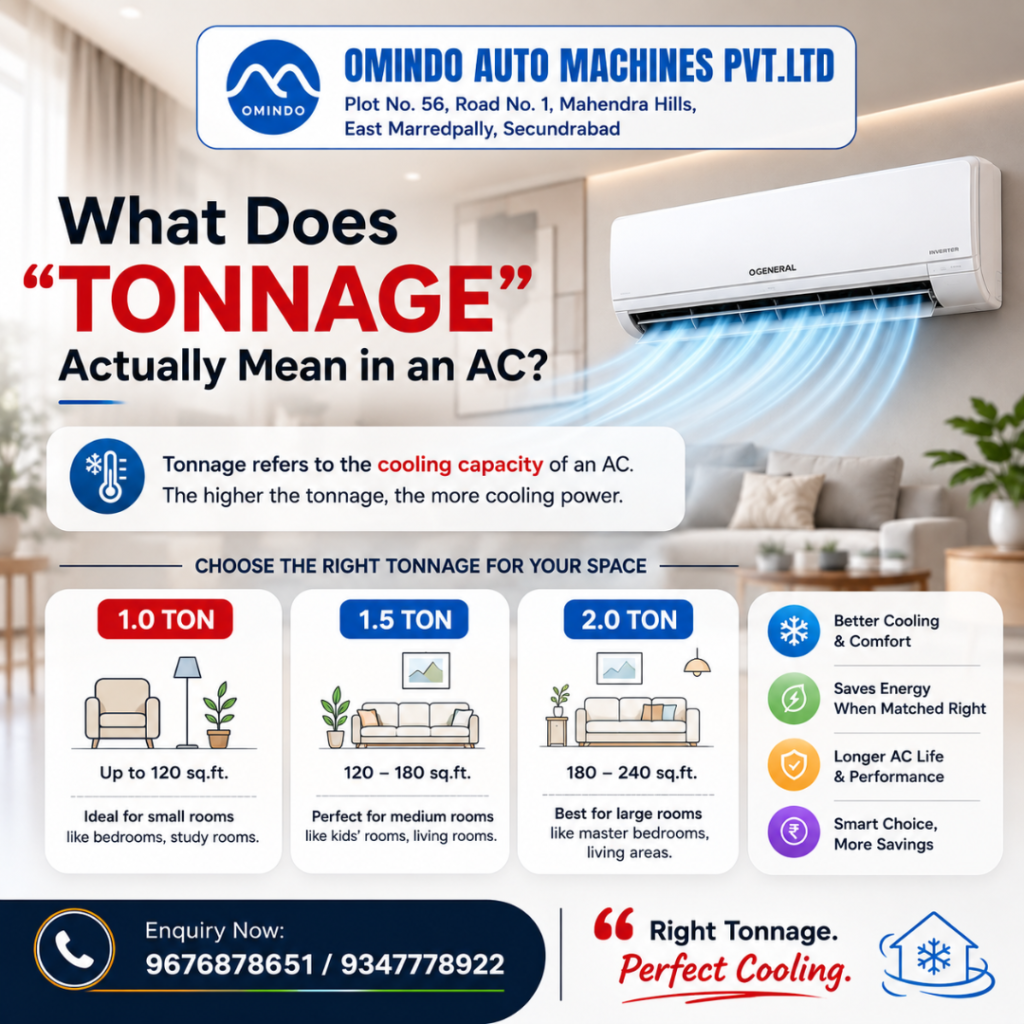
How to Choose the Right AC Tonnage for Your Home Choosing the correct air conditioner is not just about selecting a popular brand or finding the lowest price. One of the most important factors that determines cooling performance, electricity consumption, comfort, and long-term AC life is AC tonnage. Many homeowners assume that a higher tonnage means a better air conditioner, but that is not always true. An oversized AC can waste electricity, while an undersized AC may run continuously without cooling the room properly. This complete guide will help you understand what AC tonnage means, how to choose the right tonnage for your room size, and why proper sizing is essential for energy-efficient cooling in Indian homes. What Does AC Tonnage Mean? In air conditioners, tonnage refers to the cooling capacity of the AC, not its physical weight. 1 Ton AC = can remove approximately 12,000 BTU of heat per hour 1.5 Ton AC = about 18,000 BTU/hour 2 Ton AC = about 24,000 BTU/hour Simple Explanation Think of tonnage as the amount of heat an AC can remove from a room. Higher tonnage = More cooling power Lower tonnage = Less cooling power The goal is to match the cooling capacity with your room size and heat conditions. Why Choosing the Right AC Tonnage Is Important Selecting the correct tonnage affects several things: Better Cooling Comfort A properly sized AC cools the room faster and more evenly. Lower Electricity Bills An AC that matches the room size consumes less power than an oversized or undersized unit. Longer AC Lifespan Correct tonnage reduces unnecessary compressor stress, helping the AC last many more years. Improved Energy Efficiency Efficient cooling means the compressor does not need to run continuously, resulting in better energy savings. AC Tonnage Guide by Room Size 1 Ton AC Suitable Room Size Up to 120 sq.ft. Ideal For Small bedrooms Study rooms Home offices Guest rooms Advantages Lower initial cost Lower power consumption Efficient for compact spaces If your room is small and receives moderate sunlight, a 1 Ton inverter split AC is usually sufficient. 1.5 Ton AC Suitable Room Size 120 to 180 sq.ft. Ideal For Medium bedrooms Children’s rooms Living rooms Dining rooms Why It Is the Most Popular Choice A 1.5 Ton AC offers the best balance between cooling performance and electricity consumption, making it the most commonly recommended option for Indian households. 2 Ton AC Suitable Room Size 180 to 240 sq.ft. Ideal For Master bedrooms Large living rooms Hall areas Office cabins Commercial rooms A 2 Ton AC is recommended when the room is large, has multiple occupants, large windows, or receives heavy afternoon sunlight. Quick Comparison Table AC Capacity Room Size Best For 1 Ton Up to 120 sq.ft. Small bedrooms, study rooms 1.5 Ton 120 to 180 sq.ft. Medium bedrooms, living rooms 2 Ton 180 to 240 sq.ft. Large rooms, halls, master bedrooms Factors That Affect AC Tonnage Selection Room size is important, but it is not the only factor. Sunlight Exposure Low sunlight → Standard tonnage is usually enough. Direct afternoon sunlight → Consider 0.5 Ton higher capacity. Number of Occupants More people generate more body heat. 1–2 people → Standard recommendation 3–5 people → Consider a slightly higher capacity Large family usage → Prefer 1.5 Ton or 2 Ton models Ceiling Height Rooms with ceilings higher than 10 feet require additional cooling capacity because there is more air volume to cool. Electronic Appliances TVs, computers, refrigerators, gaming consoles, and other appliances produce heat that increases the cooling load. 1 Ton vs 1.5 Ton vs 2 Ton AC Which AC Is Best for a Bedroom? Bedroom Size Recommended AC Small (up to 120 sq.ft.) 1 Ton Medium (120–160 sq.ft.) 1.5 Ton Large (160–220 sq.ft.) 2 Ton For most modern Indian bedrooms, 1.5 Ton inverter ACs are the safest and most efficient choice. Common Mistakes When Choosing AC Tonnage Buying a Smaller AC to Save Money This often results in: Continuous compressor operation Poor cooling Higher electricity bills Reduced compressor life Buying an Oversized AC A larger AC may cool the room quickly but can: Turn ON and OFF frequently Consume unnecessary power Remove less humidity Create uneven cooling The correctly sized AC is always more efficient than an oversized one. Best AC Tonnage for Hyderabad Homes Hyderabad experiences hot and dry summers, with temperatures often crossing 40°C. Recommended Tonnage Room Type Hyderabad Recommendation Small Bedroom 1 Ton Medium Bedroom 1.5 Ton Living Room 1.5 Ton or 2 Ton Large Hall 2 Ton For homes on top floors or west-facing apartments, choosing 0.5 Ton higher capacity can improve comfort during peak summer months. Inverter AC vs Non-Inverter AC When selecting tonnage, it is also important to choose the right technology. Inverter AC Advantages Adjusts compressor speed automatically Maintains a stable temperature Consumes less electricity Operates more quietly Provides better long-term savings A 1.5 Ton Inverter Split AC is often more efficient than a 2 Ton non-inverter AC used in the same medium-sized room. Frequently Asked Questions (AEO Optimized) What size AC do I need for a 150 sq.ft. room? A 1.5 Ton AC is generally the best choice for a 150 sq.ft. room. Is 1 Ton AC enough for a bedroom? Yes, a 1 Ton AC is enough for a bedroom up to 120 sq.ft. if the room has normal ceiling height and moderate sunlight exposure. Which AC consumes less electricity: 1 Ton or 1.5 Ton? A 1 Ton AC consumes less power, but only when used in a room that actually requires 1 Ton cooling. Using a smaller AC in a larger room can increase electricity usage because it runs continuously. How do I calculate AC tonnage for my room? A simple estimate: Up to 120 sq.ft. → 1 Ton 120–180 sq.ft. → 1.5 Ton 180–240 sq.ft. → 2 Ton Additional factors such as sunlight, occupancy, and ceiling height should also be considered. Expert Tips Before Buying an AC Measure the Room Correctly Calculate: Room Length × Room Width

How to Choose the Right AC Tonnage for Your Home Read More »

Best AC Dealer & Distributor in Secunderabad

Best AC Dealer & Distributor in Secunderabad

Your Trusted OEM Dealer & Distributor of Premium Air Conditioning Brands in Hyderabad Finding the right air conditioning dealer is just as important as choosing the right AC brand. Whether you need a Split AC for your home, a Cassette AC for a showroom, a Tower AC for a commercial space, or a Ductable AC for industrial applications, buying from an authorized OEM dealer and distributor ensures product authenticity, warranty protection, expert support, and long-term reliability. Omindo Auto Machines Pvt. Ltd is a trusted OEM partner in Hyderabad and Secunderabad, offering premium air conditioning solutions from leading brands such as O General, Carrier, Toshiba, Voltas, and IFB. This guide explains why choosing an OEM-authorized AC dealer matters, the types of air conditioners available, and how professional consultation helps you get the best cooling performance and energy savings. What Does an OEM Dealer Mean? An OEM (Original Equipment Manufacturer) Dealer is an authorized partner that supplies genuine products directly from recognized manufacturers. Benefits of Buying from an OEM Dealer 100% authentic products Manufacturer-backed warranty Latest models and technologies Professional installation support Access to genuine spare parts Reliable after-sales service Better product knowledge and consultation Buying from unauthorized sources may result in limited warranty support, duplicate accessories, improper installation, and reduced product lifespan. Premium AC Brands Available O General Air Conditioners O General is known for: Powerful cooling performance High durability Excellent performance in extreme summer temperatures Reliable long-term operation Best suited for homes, offices, retail stores, and commercial spaces in Hyderabad’s hot climate. Carrier Air Conditioners Carrier offers: Advanced cooling technology Energy-efficient inverter systems Smart airflow management Quiet operation Ideal for residential and commercial applications requiring efficient and consistent cooling. Toshiba Air Conditioners Toshiba is recognized for: Innovative compressor technology Energy-saving performance Low-noise operation Modern design and intelligent controls A strong choice for premium residential and office environments. Voltas Air Conditioners Voltas provides: Wide range of cooling solutions Affordable and efficient models Strong service network Reliable performance for Indian weather conditions Suitable for homes, shops, restaurants, and small businesses. IFB Air Conditioners IFB ACs are popular for: Inverter energy efficiency Fast cooling Air purification features Stylish indoor units Excellent for modern apartments and family homes. Wide Range of Air Conditioning Solutions Omindo Auto Machines Pvt. Ltd supplies multiple categories of air conditioners to meet residential, commercial, and industrial cooling requirements. 1. Split Air Conditioners Best For Bedrooms Living rooms Apartments Small offices Key Advantages Quiet operation Faster cooling Energy-efficient inverter technology Sleek and modern appearance Better air circulation Split ACs are currently the most preferred option for modern homes in Hyderabad because they provide superior comfort and lower electricity consumption. 2. Cassette Air Conditioners Best For Showrooms Retail stores Restaurants Conference rooms Commercial offices Key Advantages 360-degree airflow Uniform cooling across large areas Ceiling-mounted design saves wall space Professional commercial appearance Cassette ACs are ideal when large spaces require even cooling distribution. 3. Tower Air Conditioners Best For Banquet halls Reception areas Large living spaces Temporary event cooling Key Advantages High airflow capacity Quick cooling for larger rooms Easy installation without major wall modifications Portable positioning flexibility 4. Ductable Air Conditioners Best For Hotels Hospitals Office buildings Factories Large commercial facilities Key Advantages Centralized cooling system Hidden duct-based installation Low indoor noise Uniform temperature control across multiple rooms Clean and premium interior aesthetics Ductable systems are the preferred solution for large-scale commercial and industrial projects. Why Choose Omindo Auto Machines Pvt. Ltd? 100% Authentic Products Every AC unit is sourced through authorized OEM channels, ensuring genuine products with valid manufacturer warranty coverage. Trusted OEM Partner As an OEM-associated distributor, Omindo focuses on quality assurance, correct product selection, and professional customer support rather than simply selling equipment. Expert Cooling Consultation Choosing the wrong AC capacity can lead to: Poor cooling performance Higher electricity bills Excessive compressor wear Reduced equipment lifespan Professional guidance helps determine the correct tonnage, energy rating, and AC type based on your room size and usage pattern. Competitive Pricing Customers benefit from: Transparent pricing Brand-authorized offers Value-for-money product recommendations Better long-term ownership costs Timely Delivery Fast and organized delivery support is especially important for: New home installations Office projects Commercial renovations Seasonal AC replacement requirements Reliable After-Sales Support A quality AC purchase should include ongoing support for: Installation Maintenance Gas charging Performance inspection Spare parts replacement Periodic servicing Strong after-sales service helps maintain cooling efficiency and equipment durability for many years. Residential Cooling Solutions For homes and apartments, the most common recommendations are: Room Type Recommended AC Small Bedroom 1 Ton Split AC Medium Bedroom 1.5 Ton Split AC Living Room 1.5 Ton or 2 Ton Split AC Large Hall 2 Ton Split AC or Tower AC Important Factors Room size Sunlight exposure Number of occupants Floor level Daily usage hours Selecting the right configuration improves comfort, energy savings, and cooling speed. Commercial Cooling Solutions Businesses require cooling systems that operate efficiently for longer working hours. Recommended Options Commercial Space Recommended System Retail Shop Cassette AC Restaurant Cassette AC Office Floor Cassette or Ductable AC Showroom Cassette AC Hotel Ductable AC Industrial Area Ductable AC Commercial systems should be designed with airflow planning, heat load calculation, and energy efficiency considerations. Energy Efficiency Matters Electricity consumption is one of the biggest concerns for AC buyers. Tips to Reduce AC Power Consumption Choose Inverter AC models Prefer 4-Star or 5-Star energy ratings Keep temperature between 24°C and 26°C Clean filters regularly Ensure proper room insulation Schedule periodic professional servicing Modern inverter systems can significantly reduce energy usage compared to older fixed-speed air conditioners. Frequently Asked Questions (AEO Optimized) Which AC brand is best for Hyderabad weather? O General, Carrier, Toshiba, Voltas, and IFB all offer models suitable for Hyderabad’s high summer temperatures. O General is particularly known for powerful cooling in extreme heat conditions. Why should I buy from an OEM dealer? Buying from an OEM-authorized dealer ensures genuine products, official warranty coverage, professional installation, and reliable after-sales support. Which AC is best for a commercial office? For most commercial

Best AC Dealer & Distributor in Secunderabad Read More »

Split AC vs Window AC: Know Why Split AC Is the Smarter Choice

Split AC vs Window AC: Know Why Split AC Is the Smarter Choice

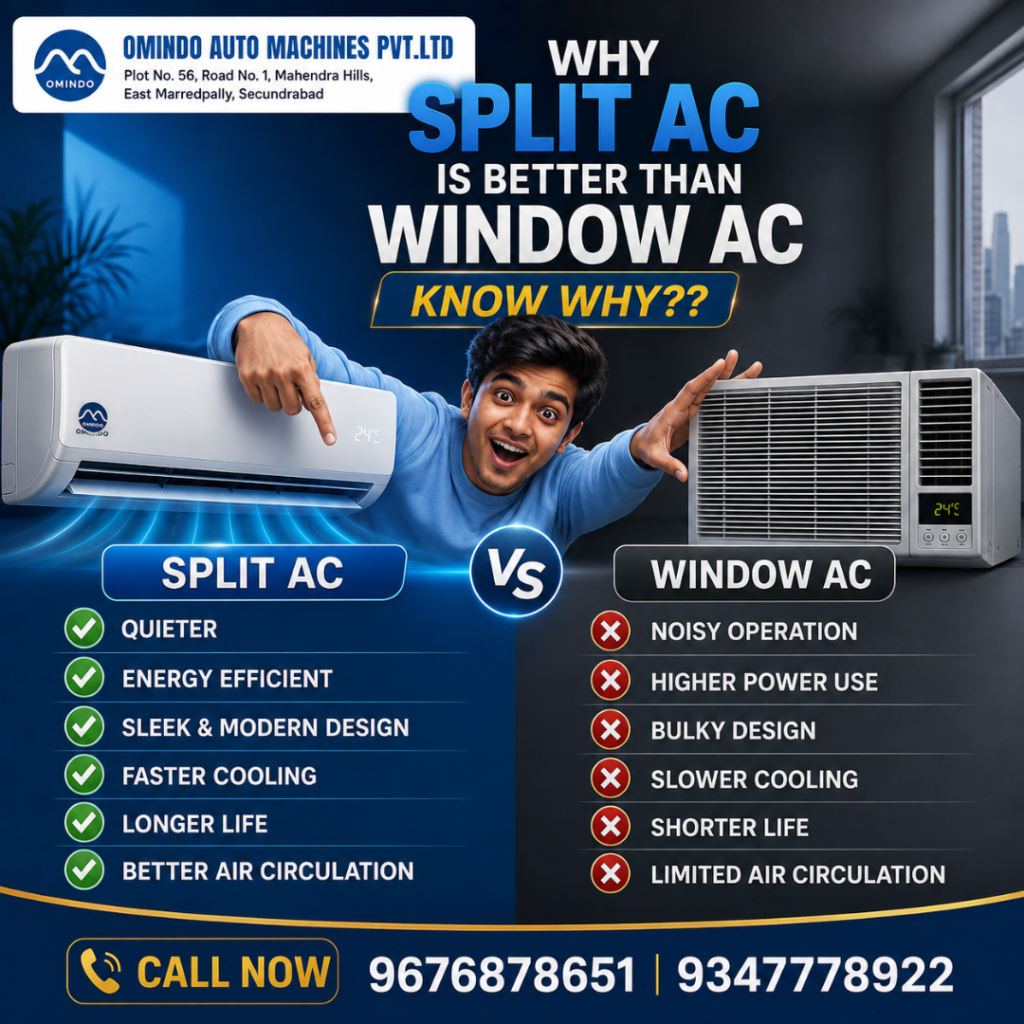
Split AC vs Window AC: Know Why Split AC Is the Smarter Choice When buying an air conditioner, one of the most common questions homeowners ask is: Which is better, Split AC or Window AC? While both types cool a room effectively, modern homes and offices are increasingly choosing Split ACs because of their energy efficiency, quieter operation, faster cooling, and sleek design. If you are planning to buy a new air conditioner in Hyderabad or anywhere in India, this detailed comparison will help you make the right decision. What Is a Split AC? A Split Air Conditioner has two separate units: Indoor Unit – Installed inside the room and blows cool air. Outdoor Unit – Installed outside the building and contains the compressor and condenser. Because the noisy compressor is placed outside, split ACs offer a much more comfortable indoor experience. What Is a Window AC? A Window Air Conditioner is a single compact unit that contains all components, including the compressor, condenser, and evaporator, in one box. It is usually installed in a window or a wall opening. Window ACs are generally less expensive initially, but they have several limitations compared to split ACs. Split AC vs Window AC: Quick Comparison Feature Split AC Window AC Noise Level Very Quiet Noisy Energy Efficiency High Moderate Cooling Speed Faster Slower Design Sleek & Modern Bulky Air Circulation Better Limited Installation Flexibility More Flexible Requires Window Space Maintenance Easier Access Slightly Difficult Long-Term Savings Better Lower Why Split AC Is the Smarter Choice 1. Quieter Operation One of the biggest advantages of a split AC is its silent performance. Since the compressor remains outside, indoor noise is minimal. Best for: Bedrooms Study rooms Offices Conference rooms A quieter environment improves sleep quality, concentration, and overall comfort. 2. Better Energy Efficiency Modern Inverter Split ACs consume significantly less electricity than conventional window ACs. How does it save power? Compressor adjusts speed automatically. Maintains a stable temperature. Avoids frequent ON/OFF cycles. Reduces electricity consumption during long usage hours. For families using AC for 6–10 hours daily, a split AC can lead to noticeable savings on monthly power bills. 3. Faster Cooling Performance Split ACs are designed with powerful airflow systems that distribute cool air evenly across the room. Benefits of faster cooling: Quick temperature reduction. Comfortable environment within minutes. Better cooling in larger rooms. Improved performance during peak summer temperatures. Window ACs often struggle to cool large spaces uniformly. 4. Sleek and Modern Design Interior aesthetics matter in modern homes. Split ACs have a compact, elegant indoor unit that blends with contemporary decor. Window ACs protrude from the wall or window, occupying visible space and affecting the room’s appearance. 5. Better Air Circulation Split ACs use advanced airflow technology with wider swing angles and multi-directional air distribution. Advantages: Uniform cooling in all corners. Reduced hot spots. Improved comfort for multiple people in the room. Better air movement in larger spaces. This is especially useful for living rooms, offices, showrooms, and commercial spaces. 6. Longer Lifespan Because split AC components are separated and operate more efficiently, they generally experience less vibration and wear. With proper servicing, a quality split AC can provide 10–15 years of reliable performance. Frequently Asked Questions (AEO Optimized) Which AC is better for home use: Split AC or Window AC? Split AC is better for most homes because it offers quieter operation, lower electricity consumption, faster cooling, and a more attractive design. Does a Split AC consume less electricity than a Window AC? Yes. Inverter Split ACs usually consume less power than traditional window ACs, especially when used for long hours. Is Split AC worth the higher price? Yes. Although the initial cost is higher, lower electricity bills, better comfort, and longer lifespan make split ACs more cost-effective in the long run. Which AC cools faster? Split AC cools faster due to its higher airflow capacity and more efficient cooling mechanism. Can Split AC be installed without a window? Yes. Split ACs do not require a window, making them suitable for almost any room layout. When Should You Choose a Window AC? A window AC may still be suitable if: You have a very small room. Your budget is extremely limited. You need a temporary cooling solution. A proper outdoor unit installation is not possible. However, for regular daily use, especially in urban homes and offices, split ACs provide a much better overall experience. Best Choice for Hyderabad Weather Hyderabad experiences hot summers with temperatures often crossing 40°C. In such conditions, energy-efficient cooling becomes extremely important. Recommended for Hyderabad: 1 Ton Split AC – Small bedrooms (up to 120 sq ft) 1.5 Ton Split AC – Medium bedrooms and living rooms 2 Ton Split AC – Large halls, offices, and commercial spaces Choosing an Inverter Split AC with a 5-Star energy rating can significantly reduce electricity expenses during the long summer season. Expert Buying Tips Before purchasing a split AC, check these factors: Room Size Up to 120 sq ft → 1 Ton 120–180 sq ft → 1.5 Ton 180–300 sq ft → 2 Ton Energy Rating Choose 4-Star or 5-Star models for maximum savings. Inverter Technology Always prefer Inverter Split ACs for better efficiency and temperature control. Brand Support Select brands with reliable installation and service support in your city. Final Verdict Split AC vs Window AC: Know Why Split AC Is the Smarter Choice If you want: Quieter cooling Lower electricity bills Faster temperature control Modern appearance Better air circulation Long-term durability then Split AC is clearly the smarter choice for both homes and offices. While window ACs may offer a lower upfront price, split ACs provide superior comfort, energy efficiency, and long-term value, making them the preferred option for modern air conditioning needs. For professional guidance on selecting the right Split AC in Hyderabad, including O General, Voltas, Carrier, IFB, Toshiba, and other leading brands, choose a trusted dealer who can provide expert consultation, installation, and after-sales service for the best cooling experience. Visit us:

Split AC vs Window AC: Know Why Split AC Is the Smarter Choice Read More »

What Is a Convertible AC? Cooling & Energy Saving Explained

What Is a Convertible AC? Cooling & Energy Saving Explained

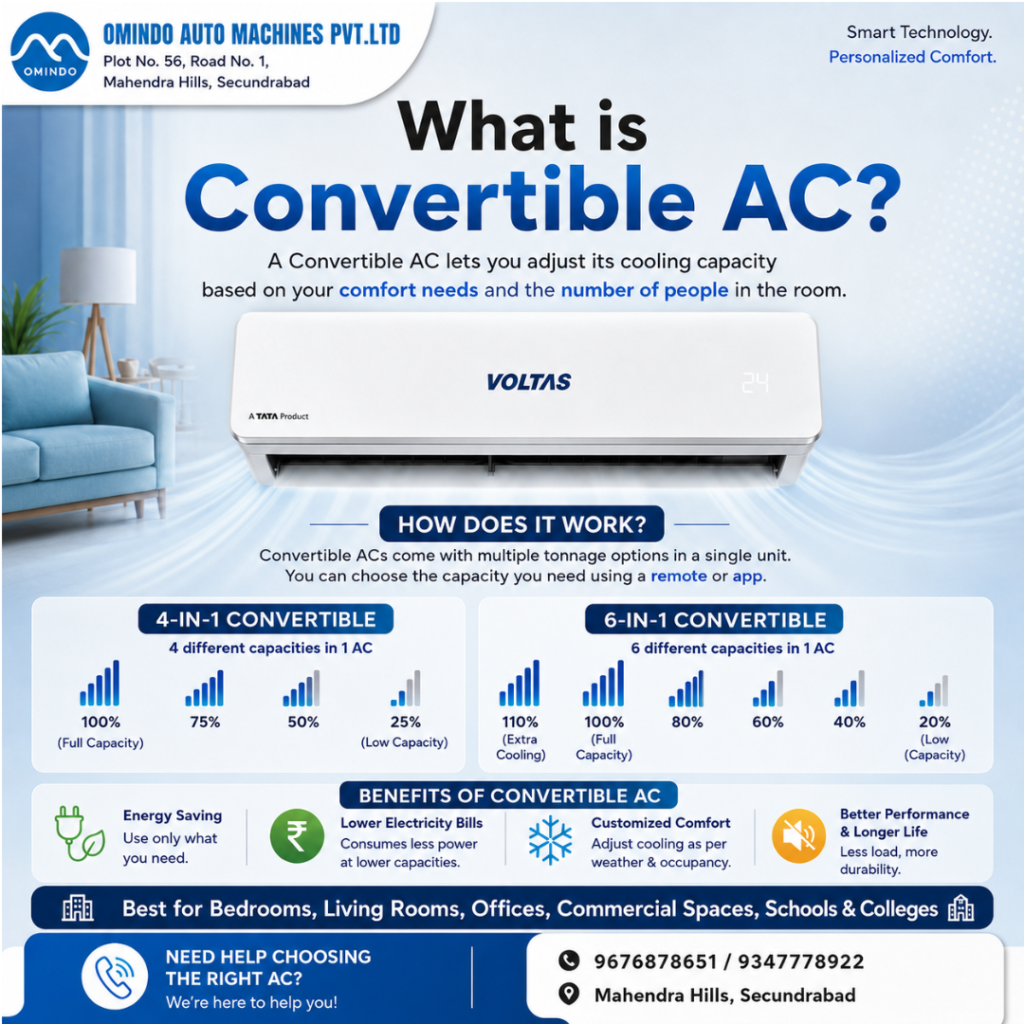
What Is a Convertible AC? Cooling & Energy Saving Explained When buying a new air conditioner, you may have noticed terms like 4-in-1 Convertible AC or 6-in-1 Convertible AC. Many people assume it is just a marketing feature, but a convertible AC is a useful technology that can help improve comfort and reduce electricity consumption when used correctly. In this guide, let’s understand what a convertible AC is, how it works, its benefits, and whether it is the right choice for your home or office. What Is a Convertible AC? A Convertible AC is an inverter air conditioner that allows you to change its cooling capacity according to the room’s requirement. Unlike traditional ACs that usually operate at a fixed or automatically varying compressor speed, a convertible AC provides multiple predefined cooling levels that can be selected using the remote control or a mobile app. For example, a 1.5 Ton Convertible AC may allow you to operate it at: 100% – Full cooling 75% – Medium-high cooling 50% – Medium cooling 25% – Low cooling Some advanced models offer 6 different cooling modes, including 110% extra cooling for extremely hot weather. How Does a Convertible AC Work? The technology works by controlling the compressor capacity. Example Imagine you have a 1.5 Ton AC: Room Situation Suggested Mode Afternoon with many people in the room 100% or 110% Evening with 3–4 people 75% or 80% Night with 1–2 people 40% or 50% Mild weather or small occupancy 20% or 25% By running the compressor at a lower capacity when full cooling is not required, the AC uses less power and reduces unnecessary load on the system. 4-in-1 vs 6-in-1 Convertible AC 4-in-1 Convertible AC 100% – Full Capacity 75% 50% 25% – Low Capacity This is suitable for most bedrooms and small living rooms. 6-in-1 Convertible AC 110% – Extra Cooling 100% – Full Capacity 80% 60% 40% 20% – Low Capacity This provides more flexibility, especially in larger rooms, offices, and areas with changing occupancy. Benefits of a Convertible AC 1. Energy Saving The biggest advantage is using only the cooling you need. If the room is already cool or only one person is present, running the AC at 40% or 50% capacity can consume less electricity than operating continuously at full capacity. 2. Lower Electricity Bills Because the compressor works at reduced capacity for longer periods, power consumption is generally lower compared to frequently running at maximum load. Important: Actual savings depend on: Room size Insulation Outdoor temperature AC star rating Usage habits 3. Customized Comfort Different people prefer different temperatures. Convertible modes allow you to adjust cooling according to comfort, weather, and occupancy. 4. Better Performance and Longer Life Operating at lower capacity can reduce stress on the compressor, which may help improve durability over time when the AC is properly maintained. Is Convertible AC Better Than a Normal Inverter AC? Feature Normal Inverter AC Convertible Inverter AC Variable compressor speed ✔️ ✔️ Manual capacity selection ❌ ✔️ Multiple cooling modes Limited ✔️ Better control over power usage Moderate Better Suitable for changing occupancy Moderate Excellent A convertible AC is essentially an advanced inverter AC with additional user-controlled cooling modes. Does Convertible Mode Really Save Electricity? Yes, it can save electricity, but it is important to understand how. It helps when: The room is not heavily occupied. Cooling demand changes throughout the day. You reduce the capacity instead of always using full mode. The room is properly insulated. It may not save much when: The room is very large for the AC size. Doors and windows are frequently open. The outdoor temperature is extremely high all the time. The AC runs continuously at 100% or 110% mode. So, convertible technology is not a magic power-saving switch, but it is a practical feature that gives you better control over energy usage. Best Places to Use a Convertible AC Bedrooms Night mode at 40% or 50% Comfortable sleep with potentially lower power consumption Living Rooms Increase capacity when guests arrive Reduce capacity when occupancy decreases Offices Adjust cooling according to the number of employees present Useful for cabins, meeting rooms, and small office spaces Commercial Spaces Shops Clinics Tuition centers Small classrooms Simple Real-Life Example Suppose you return home in the evening: Step 1: Room is hot Set the AC to 100% mode for 15–20 minutes. Step 2: Room becomes comfortable Reduce it to 60% or 50% mode. Step 3: Before sleeping Lower it further to 40% mode. This approach maintains comfort while avoiding unnecessary full-capacity operation for the entire night. Tips to Get Maximum Savings from a Convertible AC Keep the temperature between 24°C and 26°C. Use 50–60% mode once the room is cooled. Clean the air filters regularly. Keep doors and windows closed while the AC is running. Use a ceiling fan along with the AC for better air circulation. Choose the correct tonnage for your room size. Who Should Buy a Convertible AC? Recommended for: Families with changing room occupancy Users who run the AC for long hours Bedrooms and living rooms used at different times of the day Offices with varying staff strength People looking for better control over cooling and energy usage May Not Be Necessary for: Rooms that always have the same occupancy Very limited AC usage (1–2 hours occasionally) Situations where budget is the only priority and a standard inverter AC is significantly cheaper Frequently Asked Questions Is a Convertible AC an Inverter AC? Yes. Most convertible ACs are inverter air conditioners with additional capacity control modes. Which is better: 4-in-1 or 6-in-1? 4-in-1 is sufficient for most homes. 6-in-1 offers finer control and is better for larger rooms and commercial spaces. Can I change the mode anytime? Yes. The cooling mode can usually be changed using the remote control or the manufacturer’s mobile app while the AC is operating. Does 110% mode increase electricity consumption? Yes. 110% mode provides extra cooling and may consume more power than normal full-capacity operation, so

What Is a Convertible AC? Cooling & Energy Saving Explained Read More »

3-Star vs 5-Star AC: Which Air Conditioner Saves More Electricity?

3-Star vs 5-Star AC: Which Air Conditioner Saves More Electricity?

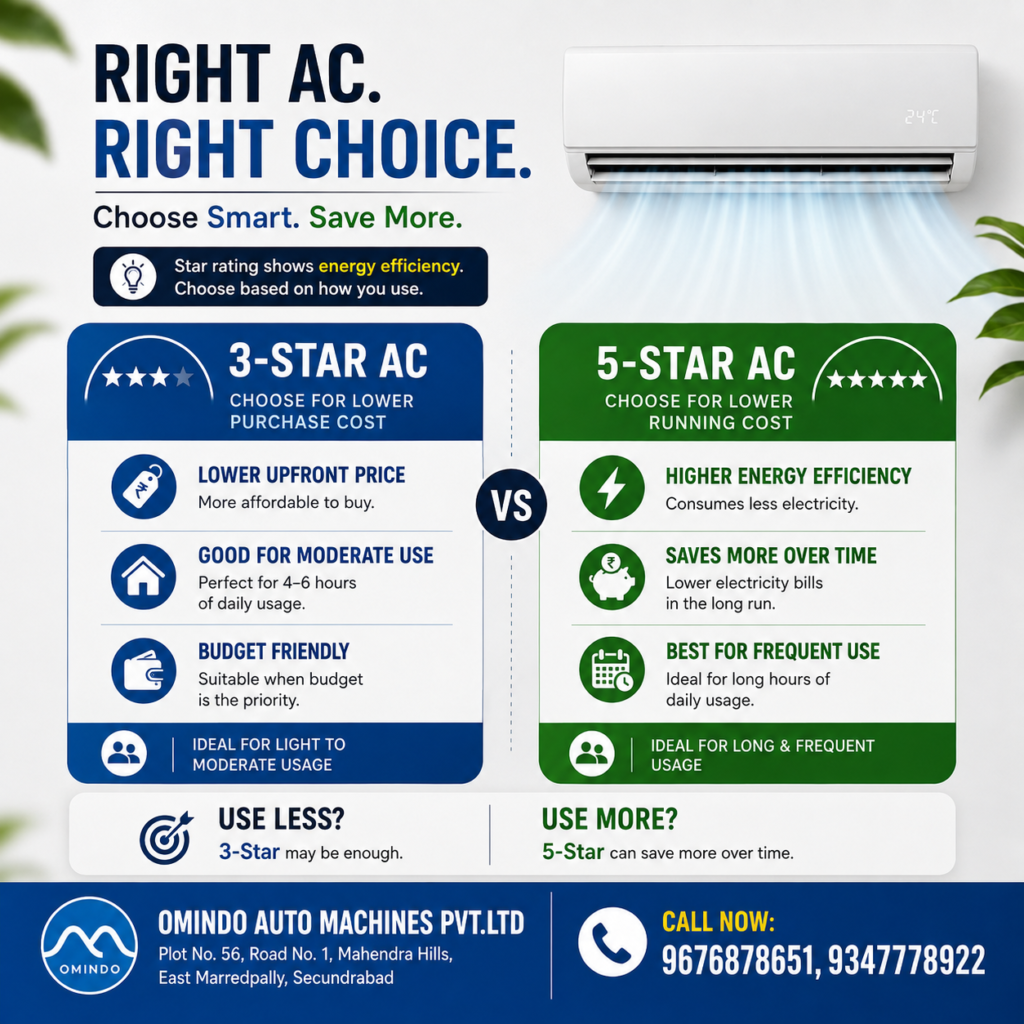
3-Star vs 5-Star AC: Which Air Conditioner Saves More Electricity? Choosing the right air conditioner is no longer just about cooling. With rising electricity costs and increasing daily AC usage, selecting between a 3-Star AC and a 5-Star AC can make a significant difference to your monthly power bill and long-term savings. Many homeowners and business owners ask the same question: “Which air conditioner saves more electricity: 3-Star or 5-Star?” In this guide, we’ll explain the differences in energy efficiency, cooling performance, operating cost, and ideal usage, helping you make a smart and cost-effective decision. What Do AC Star Ratings Mean? In India, air conditioners are rated by the Bureau of Energy Efficiency (BEE). The star rating indicates how efficiently an AC uses electricity. 3-Star AC → Moderate energy efficiency 5-Star AC → High energy efficiency The higher the star rating, the less electricity the AC consumes for the same amount of cooling. Simple Example AC Type Power Consumption Daily Usage Monthly Cost 3-Star AC Higher 8 hours Higher 5-Star AC Lower 8 hours Lower A 5-Star AC can consume 15–30% less electricity than a comparable 3-Star model, depending on the brand, inverter technology, and usage pattern. Understanding 3-Star AC Best For Homes & Residential Use A 3-Star AC is designed for users who need efficient cooling without a high initial investment. Key Advantages Lower purchase price Affordable installation cost Suitable for moderate daily usage Good cooling for small and medium rooms Ideal Usage Living rooms Bedrooms Guest rooms Small apartments Recommended Daily Usage 6–8 hours per day If your AC is used mainly during the night or only during peak summer hours, a 3-Star AC is often a practical and economical choice. Understanding 5-Star AC Best For Commercial Spaces & Heavy Use A 5-Star AC is built for users who operate the AC for long hours every day. Key Advantages Maximum energy efficiency Lower electricity bills over time Better performance during continuous operation Consistent cooling in larger spaces Ideal Usage Offices Shops Restaurants Clinics Commercial establishments Large residential spaces Recommended Daily Usage 10+ hours per day For businesses where ACs run throughout working hours, a 5-Star AC usually provides better long-term value despite the higher upfront cost. 3-Star vs 5-Star AC: Detailed Comparison Feature 3-Star AC 5-Star AC Initial Cost Lower Higher Electricity Consumption Moderate Low Best Usage Occasional / Moderate Heavy / Continuous Monthly Power Bill Higher Lower Long-Term Savings Moderate Excellent Cooling Performance Good Better & more consistent Ideal For Homes Offices & Commercial Spaces Which AC Saves More Electricity? The answer is straightforward: 5-Star AC saves more electricity. Because it uses advanced compressor technology and better energy optimization, it requires less power to maintain the same room temperature. Estimated Annual Savings Suppose a 1.5 Ton AC runs 10 hours daily: AC Type Approx. Annual Electricity Cost 3-Star AC ₹18,000 – ₹24,000 5-Star AC ₹13,000 – ₹18,000 Potential savings: ₹4,000 – ₹6,000 per year Over 5 years, the savings can easily exceed ₹20,000, which often compensates for the higher purchase price of a 5-Star AC. When Should You Choose a 3-Star AC? Choose a 3-Star AC if: You use the AC less than 8 hours daily Your budget is limited The room is used occasionally You want lower upfront investment Electricity usage is moderate Example A family using the AC only at night for 6 hours may not recover the extra cost of a 5-Star model quickly. In such cases, a 3-Star inverter AC offers a balanced combination of performance and affordability. When Should You Choose a 5-Star AC? Choose a 5-Star AC if: The AC runs all day or for long working hours You own a business or office Electricity bills are already high You want better efficiency for the next 5–10 years The room is occupied continuously Example An office operating from 9 AM to 7 PM uses the AC for nearly 10 hours daily. Here, a 5-Star AC can significantly reduce operating expenses every month. What About Inverter Technology? Many modern ACs are Inverter ACs, which automatically adjust compressor speed based on the cooling requirement. Important Point A 3-Star Inverter AC can sometimes perform better than an older non-inverter 5-Star AC. For the best efficiency, look for: 5-Star Inverter AC Copper condenser Eco mode Sleep mode Variable speed compressor Tips to Reduce AC Electricity Consumption Regardless of the star rating, these practices help save additional power: Set the Temperature Correctly Recommended: 24°C to 26°C Every 1°C lower can increase power consumption by 6–8%. Keep Filters Clean Dirty filters restrict airflow and force the compressor to work harder. Use Curtains or Blinds Reducing direct sunlight lowers the cooling load on the AC. Seal Doors and Windows Prevent cool air from escaping and warm air from entering. Schedule Regular Maintenance Professional servicing improves efficiency, cooling performance, and compressor life. Cost vs Savings: The Smart Way to Decide Choose Based on Usage Hours Daily Usage Recommended AC 1–4 hours 3-Star 4–8 hours 3-Star Inverter 8–10 hours 5-Star Inverter 10+ hours 5-Star Inverter This approach is often more accurate than choosing solely based on price. Best AC Recommendation for Different Spaces Home Bedroom 3-Star Inverter AC Cost-effective Quiet operation Sufficient for nighttime use Living Room 3-Star or 5-Star, depending on usage duration. Office Cabin 5-Star Inverter AC Lower running cost Better for daily business operations Retail Shop or Restaurant 5-Star AC Handles continuous customer traffic Maintains consistent cooling throughout the day Final Verdict: 3-Star or 5-Star? Choose 3-Star AC if: You want lower upfront cost Usage is moderate The AC is primarily for home comfort Choose 5-Star AC if: You want maximum electricity savings Usage is heavy or continuous The AC is for offices, shops, restaurants, or large spaces Quick Summary Best for Homes: 3-Star AC Best for Businesses: 5-Star AC Best for Long-Term Savings: 5-Star Inverter AC Best Budget Choice: 3-Star Inverter AC Conclusion Selecting between a 3-Star and 5-Star AC is ultimately a decision about usage pattern, electricity savings, and long-term value. A 3-Star AC

3-Star vs 5-Star AC: Which Air Conditioner Saves More Electricity? Read More »

Energy Efficient Voltas VRF AC Systems for Commercial Spaces

Energy Efficient Voltas VRF AC Systems for Commercial Spaces

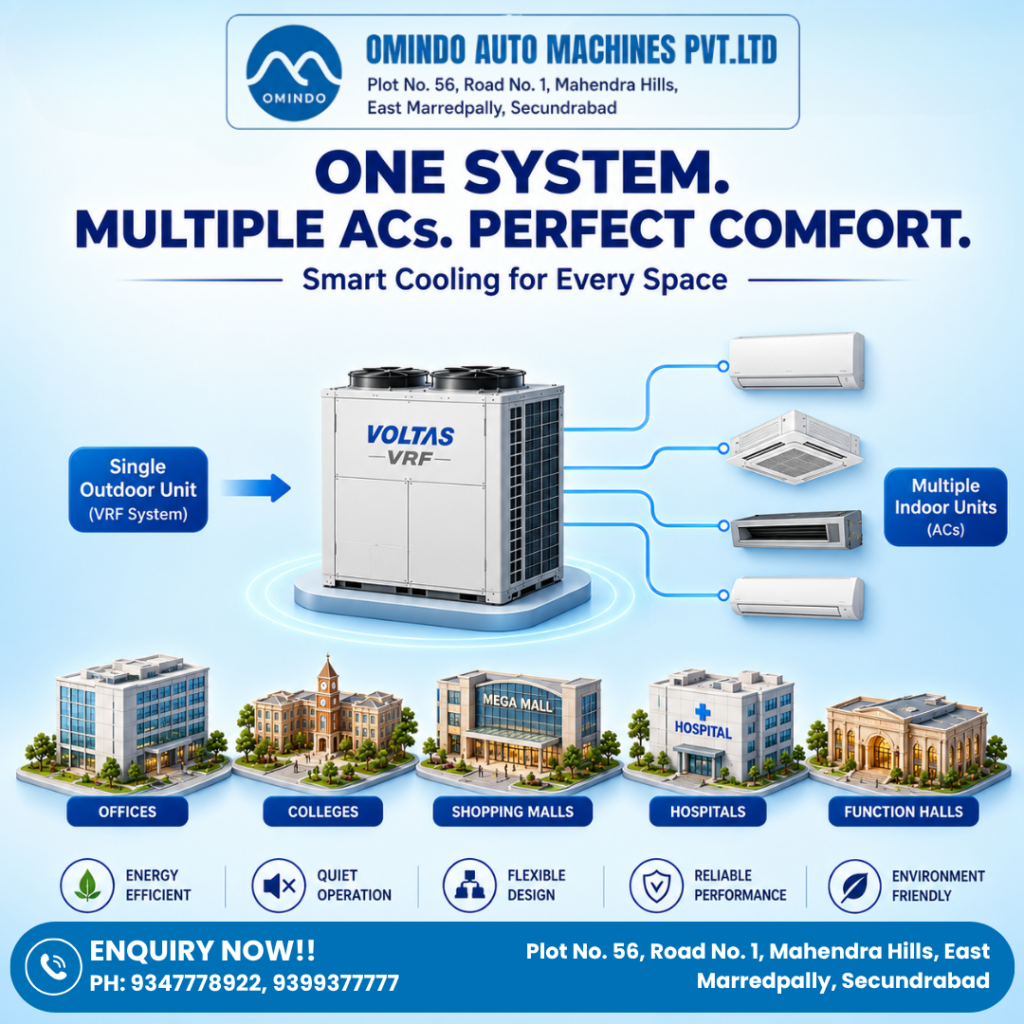
Voltas VRF Air Conditioning Systems in Hyderabad | Energy Efficient Cooling for Commercial Spaces Modern commercial buildings demand cooling systems that are powerful, energy efficient, and flexible enough to adapt to changing business needs. Traditional air conditioning systems often require multiple outdoor units, consume more electricity, and occupy valuable outdoor space. This is where Voltas VRF (Variable Refrigerant Flow) Air Conditioning Systems provide a smarter solution. At Omindo Auto Machines Pvt. Ltd., we offer Energy Efficient Voltas VRF AC Systems for Commercial Spaces in Hyderabad, helping businesses achieve superior comfort while reducing operational costs. Whether you’re planning a new commercial project or upgrading an existing HVAC system, our expert team provides complete consultation, installation, and after-sales support. What is a VRF Air Conditioning System? A VRF (Variable Refrigerant Flow) system is an advanced HVAC solution that uses one outdoor unit connected to multiple indoor units. Each indoor unit can be controlled independently, allowing different rooms or zones to maintain different temperatures based on occupancy and usage. Unlike conventional air conditioning systems, VRF technology automatically adjusts refrigerant flow according to the cooling demand, making it one of the most energy-efficient commercial cooling solutions available today. Why Choose Voltas VRF AC Systems? Voltas is one of India’s most trusted air conditioning brands, known for delivering reliable and high-performance HVAC solutions for commercial buildings. 1. Energy Efficient Operation Voltas VRF systems intelligently regulate compressor speed, reducing unnecessary power consumption and lowering electricity bills. 2. One Outdoor Unit, Multiple Indoor Units A single outdoor unit can support several indoor units, minimizing installation space while providing efficient cooling across the entire building. 3. Individual Zone Control Different rooms can maintain different temperatures independently, ensuring personalized comfort and avoiding energy wastage. 4. Quiet Performance Voltas VRF systems operate with minimal noise, making them ideal for offices, hospitals, educational institutions, and hotels. 5. Flexible Installation VRF systems are designed to suit complex building layouts and can be customized for various commercial infrastructure requirements. 6. Environment Friendly Modern Voltas VRF systems use eco-friendly refrigerants and advanced inverter technology to reduce environmental impact while maintaining excellent cooling efficiency. Applications of Voltas VRF Systems Voltas VRF Air Conditioning Systems are ideal for: Corporate Offices IT Companies Shopping Malls Hospitals & Healthcare Facilities Colleges & Universities Hotels & Resorts Banquet & Function Halls Restaurants Retail Showrooms Commercial Complexes Educational Institutions Multi-storey Buildings Benefits for Businesses Choosing a Voltas VRF system offers several long-term advantages: Lower electricity consumption Reduced maintenance costs Faster return on investment Consistent cooling performance Better indoor air comfort Smart temperature control Scalable solution for future expansion Increased equipment lifespan These benefits make VRF technology a preferred choice for architects, builders, facility managers, and business owners. Why Buy from Omindo Auto Machines Pvt. Ltd.? Omindo Auto Machines Pvt. Ltd. is a trusted supplier of premium commercial air conditioning solutions in Hyderabad. Our services include: Voltas VRF System Consultation Site Survey & Cooling Load Assessment Professional Installation Annual Maintenance Contracts (AMC) Preventive Maintenance Repair & Service Support Genuine Voltas Products Competitive Pricing Dedicated Customer Support Our experienced team ensures every installation is designed for maximum efficiency and long-term reliability. Why Hyderabad Businesses Prefer VRF Systems Commercial spaces in Hyderabad experience high cooling demands throughout much of the year. VRF technology helps businesses reduce energy expenses while maintaining consistent indoor comfort across multiple zones. This makes Voltas VRF systems an excellent investment for offices, hospitals, educational institutions, retail spaces, and commercial developments throughout the city. Conclusion If you’re looking for Energy Efficient Voltas VRF AC Systems for Commercial Spaces, Omindo Auto Machines Pvt. Ltd. offers the expertise, quality products, and reliable service you need. From consultation and system design to installation and maintenance, we provide complete HVAC solutions tailored to your business requirements. Contact our team today for a FREE site inspection and customized quotation, and experience the next generation of commercial air conditioning with Voltas VRF technology. Visit us: FLAT NO 56, Road No 1, Sanjeev Housing Society, Trimoorthy Colony, Mahendra Hills, East Marredpally, Secunderabad, Telangana 500026 Our OGeneral Showroom at : 37-127/4/1, Neredmet X Rd, Gandhi Nagar, A. S. Rao Nagar, Secunderabad, Telangana 500056 Our Voltas Showroom at : Sh no 2/3/4, Rd Number 56, Ayyappa Society, Mega Hills, Madhapur, Hyderabad, Telangana 500081 Follow us for more at @omindoautomachines_hyd, fb: Omindo Auto Machines Pvt Ltd. Our Products : Air Conditioners | Televisions | Refrigerators | Kitchen Hobs | Chimneys | Chest freezers | VRF Services  

Energy Efficient Voltas VRF AC Systems for Commercial Spaces Read More »