 OMINDO
Is a Bigger AC Better? Myth vs Fact Explained
Is a Bigger AC Better? Myth vs Fact Explained
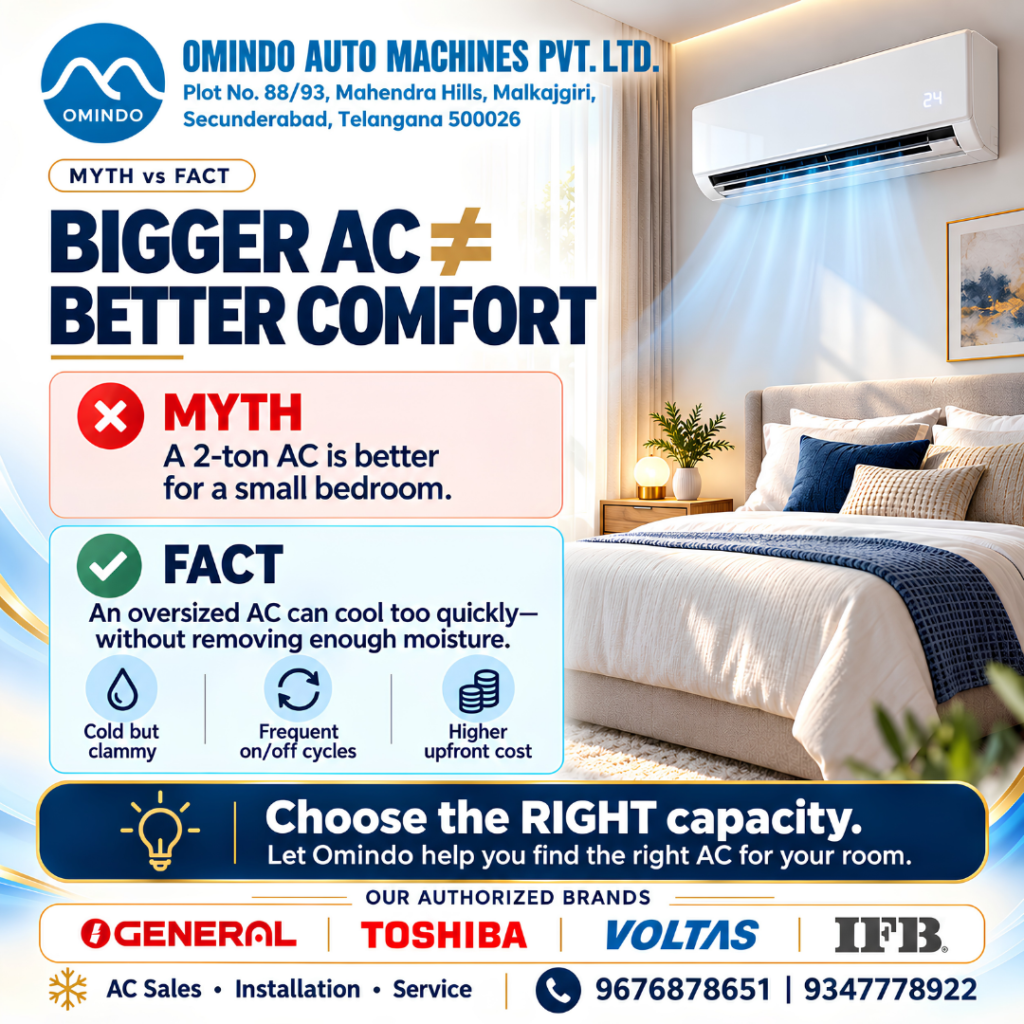
No — a bigger AC is not always better. Buying an oversized air conditioner for a small or medium room is one of the most common (and most expensive) mistakes AC buyers make. A 2-ton AC in a small bedroom cools the air fast, but it switches off before it can properly remove humidity from the room — leaving you with air that feels cold but clammy, an AC that keeps switching on and off, and a higher electricity and purchase bill than you needed to pay.
The Myth: “A Bigger AC Cools Better”
It’s a natural assumption — more tonnage should mean more cooling, so a bigger AC should cool a room faster and better. Many first-time buyers pick a 2-ton AC for a small bedroom “just to be safe,” assuming there’s no real downside to going bigger.
The Fact: An Oversized AC Can Hurt Comfort, Not Help It
An air conditioner does two jobs at once: it lowers the temperature, and it removes moisture (humidity) from the air. Removing humidity takes time — the AC needs to run continuously for a while to properly dehumidify a room. An oversized AC cools the air so quickly that it hits the set temperature and shuts off long before it has removed enough moisture.
1. Cold But Clammy Air
The room reaches the target temperature quickly, but the air still feels damp and sticky because humidity was never properly removed. This is the single most common complaint from people who buy an oversized AC.
2. Frequent On/Off Cycling (Short Cycling)
An oversized AC reaches the set temperature within minutes, shuts off, the room warms up again quickly, and the AC restarts — over and over. This is called short cycling, and it:
- Increases wear on the compressor, since the compressor works hardest during start-up
- Reduces the AC’s lifespan over time
- Wastes electricity, because frequent starts consume more power than one steady run
- Leads to uneven cooling and temperature swings across the room
3. Higher Upfront Cost, No Extra Comfort
A higher-tonnage AC costs more to buy and more to install — and in a small or medium room, that extra capacity is not just unused, it actively works against comfort. You end up paying more for a worse cooling experience.
Why Room Size Alone Doesn’t Decide AC Tonnage
Tonnage should be matched to the room’s actual cooling load, not just its floor area. The right AC size depends on:
- Room area (square feet)
- Number of occupants — more people generate more body heat
- Sunlight exposure — west-facing or heavily glazed rooms need more cooling
- Ceiling height — taller ceilings mean more air volume to cool
- Floor level and insulation — a top-floor room under a terrace heats up faster
Two rooms of the same size can genuinely need different AC tonnage. That’s why “biggest AC I can afford” is the wrong buying strategy — “right AC for this specific room” is the correct one.
General AC Tonnage Guide by Room Size
| Room Size | Typical AC Tonnage | Best For |
|---|---|---|
| Up to 120 sq. ft. | 1 Ton | Small bedroom, study room |
| 120 – 180 sq. ft. | 1.5 Ton | Medium bedroom, typical living room |
| 180 – 250 sq. ft. | 2 Ton | Large bedroom or living room, high sunlight exposure |
| 250+ sq. ft. | 2 Ton or higher / multiple units | Large halls, commercial spaces |
These are general starting points. Occupancy, sunlight and ceiling height can shift the ideal tonnage up or down within these ranges — this is exactly where a quick consultation with our team helps.
Undersized ACs Have the Opposite Problem
Going too small isn’t the answer either. An undersized AC for a large or sun-facing room runs continuously without ever reaching the set temperature, working overtime, consuming more electricity over the long run, and wearing out faster from constant strain. The goal isn’t “smaller is safer” — it’s matching capacity to the room.
Real Example: 2-Ton AC in a Small Bedroom
Take a 120 sq. ft. bedroom with one occupant and moderate sunlight — a room that only needs a 1-ton AC. Installing a 2-ton AC instead means:
- The room cools in a few minutes, and the AC shuts off almost immediately
- Humidity stays high, so the air feels cold but damp, not fresh
- The compressor restarts every few minutes through the night, disturbing sleep with cycling noise
- The electricity bill ends up higher than it would have been with the correctly sized 1-ton unit
How to Choose the Right AC Capacity — the Correct Way
- Measure your room’s area in square feet
- Note the number of people who typically use the room
- Check how much direct sunlight the room receives, and at what time of day
- Consider ceiling height and whether the room is on a top floor
- Match this against a tonnage guide — or better, get it checked by an AC professional before you buy
How Omindo Auto Machines Helps You Choose Right
At Omindo Auto Machines, we don’t push the highest-tonnage AC in the showroom — we help you pick the one that’s actually right for your room. As an authorized dealer for O General, Toshiba, Voltas and IFB, our team assesses your room size, sunlight exposure and usage pattern before recommending a tonnage, so you get real comfort and a fair electricity bill, not just a bigger price tag.
Frequently Asked Questions
Does a bigger AC cool a room faster?
Yes, a bigger AC lowers the room temperature faster — but speed isn’t the same as comfort. It shuts off before removing enough humidity, so the room ends up cold but clammy rather than properly cooled.
Is it OK to install a 2-ton AC in a small bedroom?
No, it’s not recommended. A 2-ton AC in a small bedroom will short-cycle (switch on and off frequently), leave the air humid, wear out the compressor faster and increase your electricity bill compared to a correctly sized 1-ton unit.
What is AC short cycling and why is it a problem?
Short cycling is when an AC repeatedly switches on and off in quick succession because it’s oversized for the room. It increases compressor wear, shortens the AC’s lifespan, wastes electricity and causes uneven cooling.
How do I know the right AC tonnage for my room?
As a general guide: up to 120 sq. ft. needs 1 ton, 120–180 sq. ft. needs 1.5 tons, and 180–250 sq. ft. needs 2 tons. Adjust upward for strong sunlight, more occupants, higher ceilings or top-floor rooms. For an exact recommendation, have a professional assess your room.
What happens if I buy an undersized AC instead?
An undersized AC runs continuously without properly reaching the set temperature, consumes more electricity over time and experiences faster wear from constant strain — so going too small isn’t a safe default either.
Final Takeaway
Bigger AC does not mean better comfort. The right AC is the one correctly sized for your room’s area, occupancy, sunlight and ceiling height — not the one with the highest tonnage on the price tag. Get your room’s cooling requirement assessed properly, and you’ll get better comfort, a quieter AC, a longer-lasting compressor and a lower electricity bill.
Our OGeneral Showroom at : 37-127/4/1, Neredmet X Rd, Gandhi Nagar, A. S. Rao Nagar, Secunderabad, Telangana 500056
Our Voltas Showroom at : Sh no 2/3/4, Rd Number 56, Ayyappa Society, Mega Hills, Madhapur, Hyderabad, Telangana 500081
Follow us for more at @omindoautomachines_hyd, fb: Omindo Auto Machines Pvt Ltd.
Our Products : Air Conditioners | Televisions | Refrigerators | Kitchen Hobs | Chimneys | Chest freezers | VRF