 OMINDO
How to Select the Right AC Size for Your Room in Hyderabad
How to Select the Right AC Size for Your Room in Hyderabad
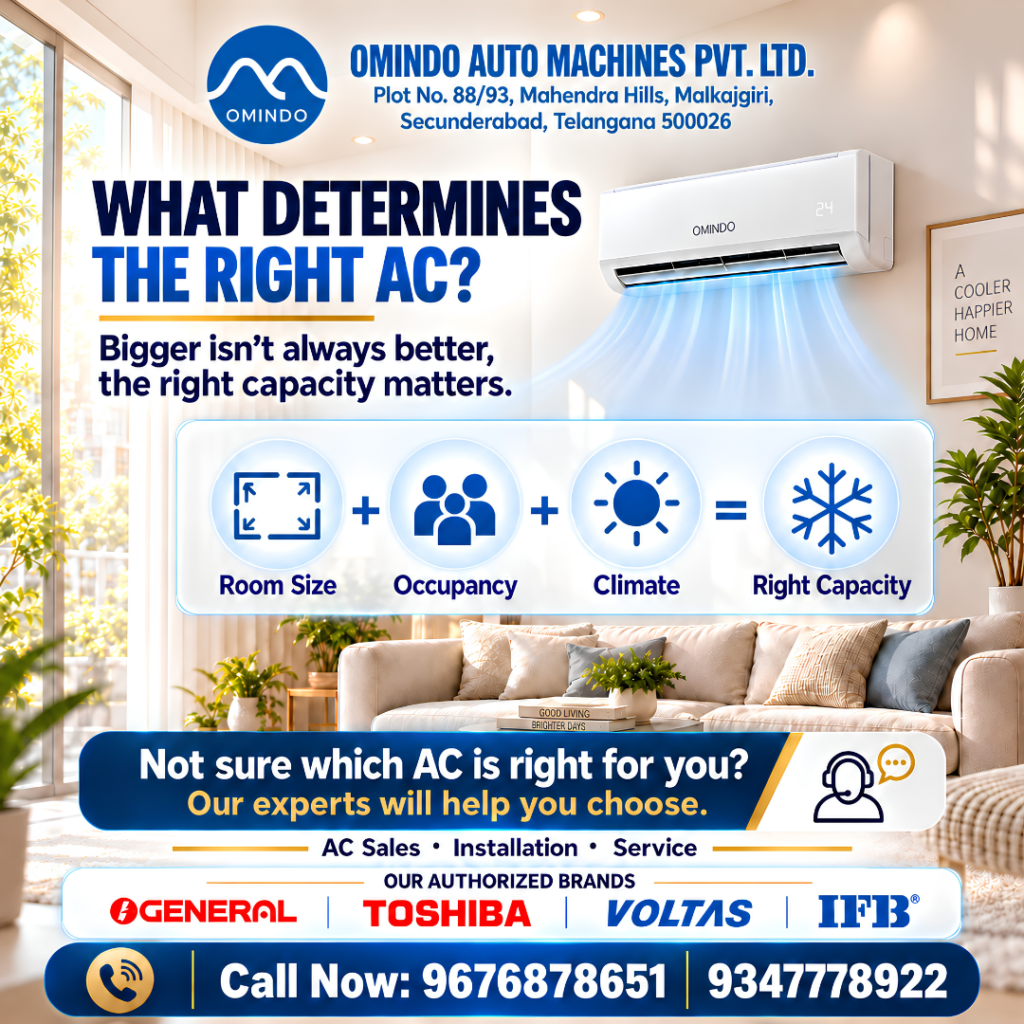
Choosing the right AC size for your room in Hyderabad depends mainly on room size, occupancy, sunlight/heat exposure, ceiling height, insulation and the local climate. As a general starting point, a smaller bedroom may suit a 1-ton AC, a typical medium-sized bedroom or living space may need around 1.5 tons, while larger rooms may require 2 tons or more. However, room area alone should not decide the purchase. A room with strong afternoon sunlight and several occupants can require more cooling capacity than a similarly sized shaded room.
Why AC Size Matters
AC capacity is commonly expressed in tons, such as 1 ton, 1.5 ton or 2 ton. Here, “ton” does not refer to the physical weight of the AC. It refers to the cooling capacity of the air conditioner.
Choosing the correct capacity helps the AC maintain the desired temperature without unnecessarily overworking the system.
For example:
- A small bedroom with limited sunlight may not need a large-capacity AC.
- A medium bedroom with two people and moderate sunlight may require a higher capacity.
- A large living room with several people, large windows and strong sunlight can have a considerably higher cooling load.
So the question shouldn’t simply be, “Which is the biggest AC I can buy?”
The better question is:
“What AC capacity matches my room’s actual cooling requirement?”
1. Start With Your Room Size
Room dimensions are the first thing to check.
Calculate:
Room Area = Length × Width
For example, if your bedroom is:
12 ft × 12 ft = 144 sq. ft.
That gives you a starting point for determining the appropriate AC capacity.
As a broad starting guide:
| Approx. Room Size | Common Starting Point |
|---|---|
| Up to ~100 sq. ft. | Around 1 Ton |
| ~100–160 sq. ft. | Around 1–1.5 Ton |
| ~160–220 sq. ft. | Around 1.5–2 Ton |
| Above ~220 sq. ft. | 2 Ton or higher may be considered |
These are guidelines, not fixed rules. Actual requirements can change significantly depending on the room’s heat load.
2. Hyderabad’s Climate Makes Heat Load Important ☀️
Room size isn’t the whole story, particularly in a hot city such as Hyderabad.
Imagine two bedrooms, both measuring 12 × 12 ft.
Room A
- North-facing
- Limited direct sunlight
- Two occupants
- Curtains/blinds
- Normal ceiling height
Room B
- West-facing
- Large glass windows
- Strong afternoon sunlight
- Three occupants
- Poor insulation
- Top-floor location
Both rooms have the same floor area, but Room B can require substantially more cooling.
This is why simply searching for an “AC for a 150 sq. ft. room” may not give you the complete answer.
3. Occupancy Also Affects Cooling
People generate heat.
A room used by one person and a room regularly occupied by four people don’t have exactly the same cooling requirement.
Scenario
Suppose you are buying an AC for a bedroom used by one or two people.
A certain capacity may be sufficient.
Now imagine the same room is converted into a small study or home office where three or four people regularly work, along with computers, monitors and other equipment.
The additional heat generated inside the room increases the cooling load.
This becomes even more important for:
- Living rooms
- Meeting rooms
- Small offices
- Commercial spaces
- Family rooms
- Entertainment rooms
4. Don’t Ignore Sunlight Exposure
Sunlight can significantly increase the heat entering a room.
A room with:
☀️ Large windows
☀️ West-facing walls
☀️ Direct afternoon sunlight
☀️ Poor curtains/blinds
☀️ Uninsulated roof
can become much hotter than a shaded room of the same size.
Example
A 140 sq. ft. bedroom on a shaded lower floor and a 140 sq. ft. bedroom directly below the roof can have very different cooling requirements.
This is particularly relevant when selecting an AC for top-floor rooms in Hyderabad.
5. Ceiling Height Matters Too
Most basic AC recommendations assume a fairly standard ceiling height.
But consider two rooms with the same floor area:
Room A: 12 × 12 ft with an 8.5 ft ceiling
Room B: 12 × 12 ft with a 12 ft ceiling
Room B contains significantly more air volume.
Therefore, when ceilings are unusually high, floor area alone isn’t enough to estimate the cooling requirement.
This is one reason professional AC recommendations may differ from simple online tonnage charts.
1 Ton vs 1.5 Ton vs 2 Ton AC: Which One?
The answer depends on your specific room.
❄️ 1 Ton AC
Generally considered for smaller rooms where the heat load is relatively low.
Typical applications can include:
- Small bedrooms
- Compact study rooms
- Small offices
❄️ 1.5 Ton AC
A common choice for medium-sized bedrooms and living spaces.
It may be suitable where there is:
- Moderate room size
- Two or more occupants
- Some sunlight exposure
- Normal ceiling height
❄️ 2 Ton AC
Generally considered for larger rooms or spaces with a higher cooling load.
Examples include:
- Large bedrooms
- Living rooms
- Larger offices
- Rooms with substantial sunlight exposure
Again, these categories are starting points rather than universal rules.
What Happens If You Buy an Oversized AC?
“Bigger is better” doesn’t always apply to air conditioners.
Suppose a relatively small room is fitted with an unnecessarily large AC.
The AC may cool the room rapidly, but that doesn’t automatically mean the overall result will be better.
AC performance involves more than simply reaching a low temperature.
Factors such as:
- Temperature control
- Humidity removal
- Compressor cycling
- Energy consumption
- Comfort
- Installation quality
also matter.
The objective should be appropriate capacity, not maximum capacity.
What Happens If the AC Is Too Small?
The opposite problem can also occur.
Imagine installing a 1-ton AC in a large room with:
- Strong afternoon sunlight
- Several occupants
- Large windows
- Poor insulation
During Hyderabad’s hotter periods, the AC may have to work continuously to maintain the desired temperature.
You may experience:
❌ Slow cooling
❌ Difficulty maintaining temperature
❌ Continuous operation
❌ Reduced comfort
❌ Higher electricity usage than expected
Therefore, choosing an undersized AC simply because it has a lower purchase price may not be the best long-term approach.
Don’t Forget the AC’s Energy Rating
After determining the approximate capacity, look at the energy efficiency rating as well.
For example, if two suitable 1.5-ton models meet your cooling requirement, you can compare:
- Star rating
- Annual energy consumption
- Inverter technology
- Cooling performance
- Warranty
- Service availability
- Features
- Purchase price
The cheapest AC isn’t necessarily the cheapest one to operate over several years.
Inverter AC or Non-Inverter AC?
For many residential applications, inverter ACs can be worth considering because the compressor can adjust its operating speed according to cooling demand.
For example, after your room reaches the desired temperature, an inverter system can modulate its operation rather than simply operating at full capacity continuously.
This can be particularly useful when the AC is used for several hours every day.
However, the right choice still depends on:
Usage hours + room conditions + electricity costs + purchase budget + model efficiency.
A Practical Hyderabad AC Selection Example
Let’s consider a real-world scenario.
Scenario 1: Small Bedroom
Room: 10 × 10 ft
Area: 100 sq. ft.
Occupancy: 1–2 people
Sunlight: Low
Usage: 7–8 hours/night
A 1-ton class AC may be a reasonable starting point to investigate.
Scenario 2: Medium Bedroom
Room: 12 × 12 ft
Area: 144 sq. ft.
Occupancy: 2 people
Sunlight: Moderate
Usage: 7–10 hours/day
A 1.5-ton class AC may be worth considering, subject to the room’s actual heat load.
Scenario 3: Large Living Room
Room: 15 × 16 ft
Area: 240 sq. ft.
Occupancy: 4–6 people
Sunlight: High
Usage: Several hours/day
A 2-ton class AC or an appropriately designed higher-capacity solution may need to be evaluated.
For larger spaces, professional assessment becomes increasingly useful rather than relying purely on a room-size chart.
What Should You Check Before Buying an AC?
Before placing your order, check these 8 factors:
1️⃣ Room Area
Measure the length and width accurately.
2️⃣ Number of Occupants
Consider how many people normally use the room.
3️⃣ Sunlight
Check whether the room receives direct morning or afternoon sunlight.
4️⃣ Ceiling Height
Higher ceilings can increase the cooling requirement.
5️⃣ Windows & Glass
Large windows can increase heat gain.
6️⃣ Floor Level
Top-floor rooms can experience higher heat loads.
7️⃣ Usage Pattern
Night-time bedroom usage is different from an AC operating throughout the day.
8️⃣ AC Efficiency & Features
Compare energy rating, inverter technology, warranty and service support after selecting the appropriate capacity.
Why Choose Omindo Auto Machines?
Choosing the correct AC isn’t only about choosing a brand. Capacity, model, installation and after-sales support all contribute to the overall ownership experience.
Omindo Auto Machines Pvt. Ltd. provides AC sales, installation and service support in Hyderabad and deals with brands including:
O General | Toshiba | Voltas | IFB
If you’re unsure whether your room needs a 1 Ton, 1.5 Ton, 2 Ton or another AC capacity, the practical approach is to evaluate your room conditions rather than purchasing purely based on price or tonnage.
📍 Omindo Auto Machines Pvt. Ltd.
Mahendra Hills, Secunderabad, Telangana
📞 9676878651 | 9347778922
Final Takeaway
The right AC size is determined by more than room area. Start with the room dimensions, then consider occupancy, sunlight, ceiling height, windows, floor level, insulation and usage pattern.
For a small room, a 1-ton AC may be sufficient. For many medium-sized rooms, 1.5 tons can be a starting point, while larger or higher-heat-load spaces may require 2 tons or more.
The goal isn’t to buy the biggest AC.
The goal is to buy the right AC for the room. ❄️
Our OGeneral Showroom at : 37-127/4/1, Neredmet X Rd, Gandhi Nagar, A. S. Rao Nagar, Secunderabad, Telangana 500056
Our Voltas Showroom at : Sh no 2/3/4, Rd Number 56, Ayyappa Society, Mega Hills, Madhapur, Hyderabad, Telangana 500081
Follow us for more at @omindoautomachines_hyd, fb: Omindo Auto Machines Pvt Ltd.
Our Products : Air Conditioners | Televisions | Refrigerators | Kitchen Hobs | Chimneys | Chest freezers | VRF