 OMINDO
What Is an Inverter AC? How Inverter Technology Actually Works
What Is an Inverter AC? How Inverter Technology Actually Works
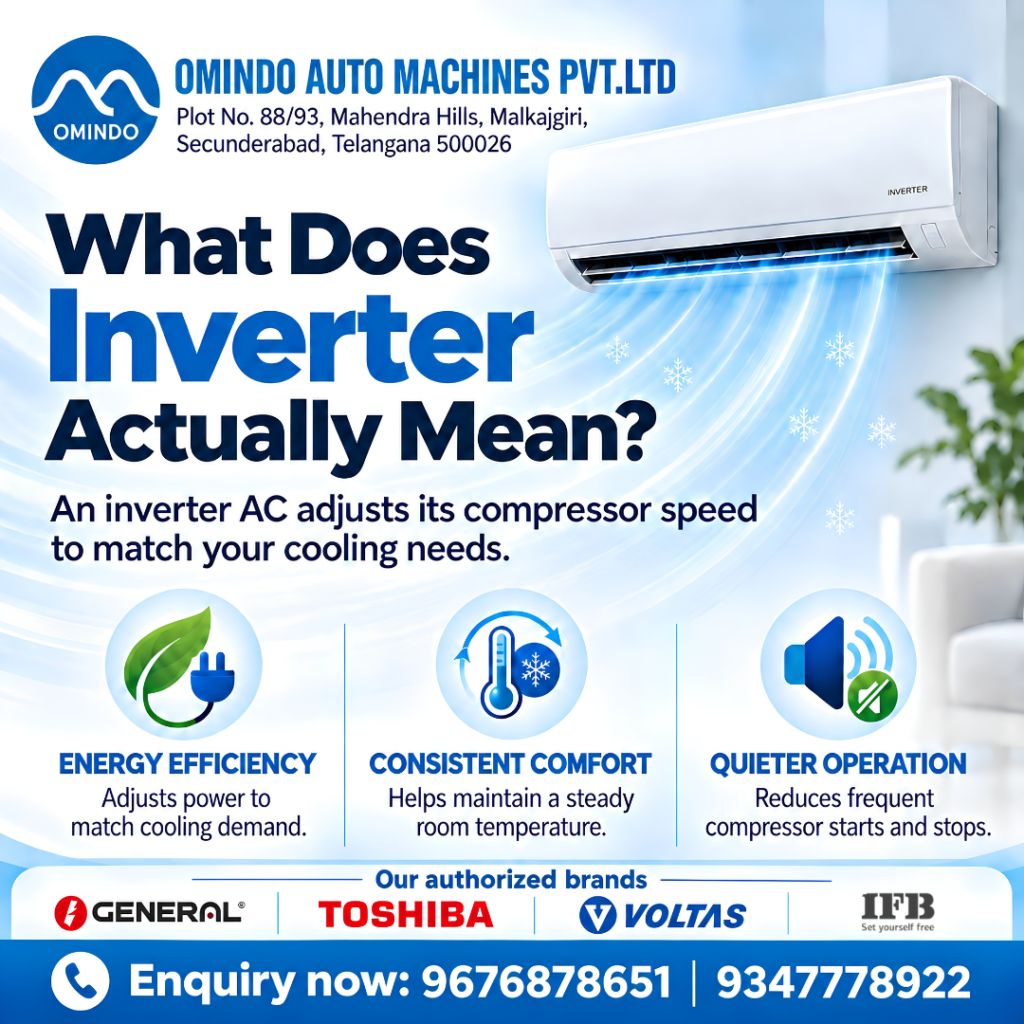
An inverter AC is an air conditioner that can vary the speed of its compressor according to the cooling requirement of the room. Instead of repeatedly running the compressor at full capacity and switching it completely off, an inverter AC can increase or reduce compressor speed to match the heat load. This can help maintain a more stable room temperature, reduce unnecessary power consumption during part-load operation, and provide quieter operation. ENERGY STAR also describes variable-speed compressors as a technology that continuously adjusts cooling output rather than relying only on full-power ON/OFF cycles.
How Does an Inverter AC Work?
To understand inverter technology, first imagine a conventional fixed-speed AC.
A fixed-speed compressor generally has two basic states:
ON → compressor operates at its rated capacity
OFF → compressor stops
When the room becomes warmer than the set temperature, the compressor starts. Once the desired temperature is reached, it stops. As the room warms up again, it starts once more.
An inverter AC works differently. Its compressor speed can be adjusted according to the cooling requirement.
For example, suppose your AC is set to 24°C.
- 🌡️ Room is very hot → compressor increases speed
- ❄️ Room approaches 24°C → compressor gradually reduces speed
- 🛋️ Room is already comfortable → compressor can operate at a lower output
- ☀️ More heat enters the room → compressor increases output again
This variable operation is the fundamental difference between inverter AC technology and conventional fixed-speed AC technology.
Why Does Compressor Speed Matter?
The cooling requirement of a room is not constant throughout the day.
Consider a bedroom on a summer afternoon.
At 2 PM:
- Outdoor temperature is high
- Sunlight may enter through windows
- More heat enters the room
- People and appliances generate additional heat
The AC may need to work harder.
At 11 PM:
- Outdoor temperature may be lower
- Direct sunlight is gone
- The room has already cooled
- Cooling demand is lower
An inverter AC can respond to these changing conditions by adjusting compressor operation.
This is particularly useful when an AC operates for several hours because the cooling load is not always at its maximum.
Inverter AC vs Non-Inverter AC
| Feature | Inverter AC | Fixed-Speed AC |
|---|---|---|
| Compressor operation | Variable speed | Mainly ON/OFF |
| Cooling output | Adjusts according to demand | Generally fixed output |
| Temperature control | More continuous | More cycling |
| Part-load efficiency | Can be better | Generally lower |
| Noise during operation | Can be quieter | More noticeable cycling/start-stop |
| Long operating hours | Well suited to variable loads | More frequent cycling |
| Initial purchase price | Usually higher | Usually lower |
However, inverter does not automatically mean that every inverter AC will consume the same amount of electricity.
Actual electricity consumption depends on several factors, including:
ISEER/energy-efficiency rating + AC capacity + room size + outdoor temperature + set temperature + operating hours + insulation + installation quality + maintenance.
That is why simply choosing the word “inverter” is not enough when buying an AC.
Real-World Evidence: How Much Energy Can Inverter ACs Save?
The actual difference varies considerably with climate, cooling load, operating conditions and equipment.
Case Study 1: Public Offices in Istanbul
A field study conducted in two identical public office rooms in Istanbul compared a constant-speed AC with a variable-speed/inverter AC.
The study covered 64 days, with the air conditioners operated intermittently for 43 days.
The researchers found that the inverter AC’s energy-saving ratio compared with the constant-speed AC varied between 11% and 38%, depending on operating conditions. The study also found that lower cooling loads could reduce the advantage of variable-speed operation because the inverter could move toward ON/OFF operation at loads below its minimum rated capacity.
What does this mean for a consumer?
It means you should not expect one fixed percentage such as “inverter AC always saves 30% electricity.”
The saving depends on how the AC is used and how much cooling the room actually requires.
Case Study 2: Hot-Climate Testing in Saudi Arabia
Another experimental study compared inverter and constant-speed air conditioners under controlled climate conditions representing South Korea and Riyadh, Saudi Arabia.
The study reported inverter energy savings of approximately:
- 18.3% to 47.1% during the simulated Riyadh cooling period
- 36.3% to 51.7% during the simulated Seoul cooling period
The researchers also found that the savings varied with outdoor temperature and cooling load. In the modeled comparison, the estimated payback period for the inverter system was approximately 2.5 years.
These numbers should be understood as study results under specific experimental conditions, not as a guaranteed saving for every home.
A Simple Electricity Example
Let’s take a simple example to understand the mathematics.
Suppose an AC effectively averages 1.0 kW of electrical consumption while operating under a particular condition.
If it operates for:
8 hours/day × 30 days = 240 hours/month
Then:
1.0 kW × 240 hours = 240 kWh/month
If another operating setup reduces average consumption by 20% under the same conditions:
240 × 20% = 48 kWh
So the consumption becomes approximately:
240 − 48 = 192 kWh/month
At an illustrative electricity rate of ₹8/kWh:
48 × ₹8 = ₹384/month
This is only an illustrative calculation, not a promise of savings from a particular inverter AC. Your actual electricity bill depends on the AC’s efficiency, load, usage hours, tariff and operating conditions.
Does Inverter AC Mean Lower Electricity Bills?
It can, particularly when the AC operates for long periods and frequently runs under partial cooling loads.
But there is an important point many buyers miss.
Inverter technology is only one part of the equation.
Before purchasing an AC, check:
1. Correct AC Capacity
A 1-ton, 1.5-ton or 2-ton AC should be selected according to the room’s cooling requirement.
An oversized AC isn’t automatically better. ENERGY STAR notes that an improperly sized AC can waste energy and may provide poorer comfort because it can cool the space before adequately removing humidity.
2. Energy Rating and ISEER
For Indian consumers, look at the BEE energy label and ISEER value rather than judging efficiency only by the word “inverter.”
BEE separately recognizes variable-speed room air conditioners within its appliance efficiency programme.
3. Set Temperature
Running an AC at extremely low temperatures increases the cooling load.
A sensible temperature setting combined with proper insulation and appropriate AC sizing can make a meaningful difference to energy consumption.
4. Installation Quality
Even an efficient AC cannot perform properly if it is poorly installed.
Correct refrigerant piping, insulation, drainage, electrical connections, outdoor-unit placement and airflow are important.
5. Regular Maintenance
Dirty filters and coils can restrict airflow and make the system work harder.
Regular servicing helps maintain airflow, cooling performance and overall system efficiency.
Is an Inverter AC Always Better?
The answer depends on your usage pattern and requirements.
If you use an AC for only a short period occasionally, the higher purchase price of an inverter model may need to be considered against the expected operating savings.
If you operate an AC for several hours every day, especially for bedrooms, living rooms, offices or commercial spaces, variable-speed operation can become more relevant because cooling demand changes throughout the operating period.
The right decision should therefore consider:
Room size + usage hours + climate + AC capacity + ISEER + electricity tariff + budget + installation + after-sales support.
Why Choose Omindo Auto Machines?
Choosing an AC is not only about buying the indoor and outdoor units. Correct product selection, genuine products, installation and after-sales support are equally important.
Omindo Auto Machines Pvt. Ltd. is a consumer electronics and home-appliance distributor serving customers in Hyderabad and Secunderabad.
Omindo deals in AC sales, installation and service, helping customers select suitable air-conditioning solutions for residential as well as commercial requirements.
The company deals with leading brands including:
- O General
- Toshiba
- Voltas
- IFB
Omindo works with OEM/brand distribution channels and provides sales and service support, helping customers with product selection, installation and after-sales requirements.
For customers comparing inverter ACs in Hyderabad, the important goal is not simply finding the cheapest AC. It is about finding the right capacity, efficiency, features, genuine product and dependable support for the intended application.
Final Takeaway
An inverter AC works by varying compressor speed instead of relying only on repeated full-power ON/OFF cycles. This allows the system to respond to changing cooling demand and can improve energy efficiency, temperature stability and operating comfort, particularly under part-load conditions. Real-world and experimental studies have demonstrated meaningful energy differences between variable-speed and fixed-speed systems, but the percentage varies with climate, load and usage.
So, when buying an AC, don’t ask only:
“Is it an inverter AC?”
Also ask:
“Is the capacity correct? What is the ISEER rating? How many hours will I use it? Is the installation reliable? And who will support me after the purchase?”
That combination is what turns an AC purchase into a smart cooling investment.
Looking for an Inverter AC in Hyderabad?
Explore inverter AC options from O General, Toshiba, Voltas and IFB through Omindo Auto Machines.
📞 Enquiries: 9676878651 | 9347778922
📍 Mahendra Hills, Secunderabad, Telangana
Our OGeneral Showroom at : 37-127/4/1, Neredmet X Rd, Gandhi Nagar, A. S. Rao Nagar, Secunderabad, Telangana 500056
Our Voltas Showroom at : Sh no 2/3/4, Rd Number 56, Ayyappa Society, Mega Hills, Madhapur, Hyderabad, Telangana 500081
Follow us for more at @omindoautomachines_hyd, fb: Omindo Auto Machines Pvt Ltd.
Our Products : Air Conditioners | Televisions | Refrigerators | Kitchen Hobs | Chimneys | Chest freezers | VRF