 OMINDO
SEER vs EER: Which AC Rating Is Better?
SEER vs EER: Which AC Rating Is Better?
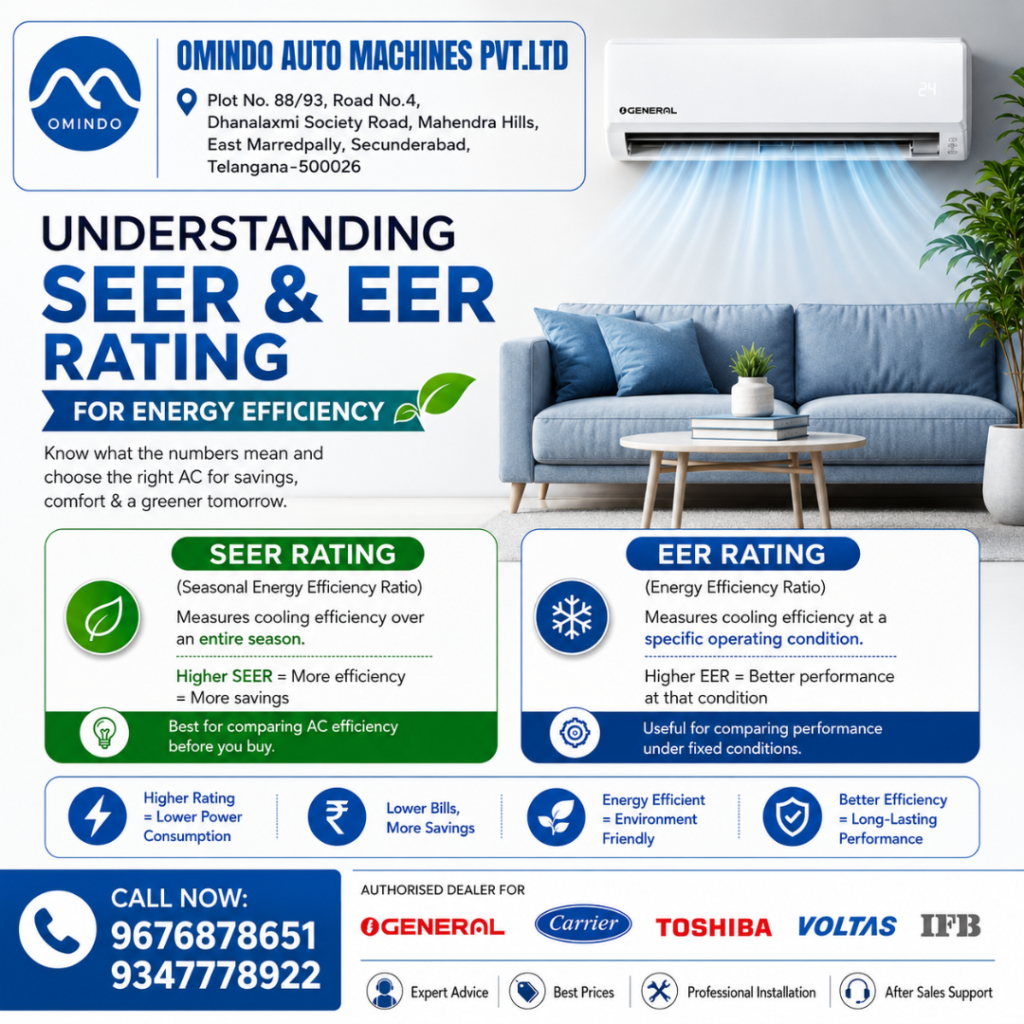
When buying an air conditioner, energy efficiency is one of the most important factors to consider. Two terms you may come across are SEER and EER. Both ratings help you understand how efficiently an AC uses electricity to provide cooling, but they measure performance in different ways.
So, SEER vs EER: Which AC rating is better?
The simple answer is: SEER is more useful for understanding seasonal energy efficiency, while EER is useful for comparing AC performance under a specific operating condition. For buyers in India, it is also important to understand ISEER and the BEE star rating, which are commonly used on AC energy labels.
Let’s break it down in simple language.
What Is EER in an Air Conditioner?
EER stands for Energy Efficiency Ratio.
It measures how efficiently an air conditioner provides cooling under a specific set of operating conditions.
In simple terms:
EER tells you how efficiently an AC performs at a particular condition.
A higher EER generally means the AC can provide more cooling for the electricity it consumes under that test condition.
EER Formula
EER = Cooling Capacity (BTU/hour) ÷ Power Consumption (Watts)
For example, if an AC provides 12,000 BTU/hour of cooling while consuming 1,000 watts:
EER = 12
This means the AC provides 12 BTU of cooling for every watt of electricity consumed under the specified test condition.
What Is SEER in an Air Conditioner?
SEER stands for Seasonal Energy Efficiency Ratio.
Unlike EER, which evaluates performance at a specific condition, SEER considers AC efficiency across a range of conditions over a cooling season.
This makes SEER particularly useful for understanding how an air conditioner may perform as outdoor temperatures and operating conditions change.
In Simple Words
- EER = Efficiency at a specific operating condition
- SEER = Efficiency across a cooling season
A higher SEER generally indicates better seasonal energy efficiency.
SEER vs EER: What Is the Difference?
| Feature | EER | SEER |
|---|---|---|
| Full Form | Energy Efficiency Ratio | Seasonal Energy Efficiency Ratio |
| Measures | Efficiency at a specific condition | Seasonal cooling efficiency |
| Operating Conditions | Fixed test condition | Multiple/seasonal conditions |
| Useful For | Specific-condition comparison | Overall seasonal efficiency |
| Higher Rating | Generally better efficiency | Generally better seasonal efficiency |
Which Is Better: SEER or EER?
There isn’t a simple “SEER is always better than EER” answer because they measure different aspects of AC efficiency.
Choose SEER When You Want to Understand:
- Seasonal energy efficiency
- Long-term cooling performance
- Expected efficiency across changing outdoor temperatures
- How efficiently an AC operates over a cooling season
Use EER When You Want to Compare:
- Performance under a particular condition
- Cooling output against electricity consumption
- AC efficiency at a defined test temperature
Therefore, SEER is generally more useful for understanding seasonal efficiency, while EER is useful for specific-condition performance comparisons.
Why Does AC Energy Efficiency Matter?
An air conditioner can be one of the larger electricity-consuming appliances in a home, particularly during hot weather.
Choosing an efficient AC can help you achieve:
Lower Electricity Consumption
A more efficient air conditioner can provide the required cooling while using less electricity.
Lower Cooling Costs
Lower electricity consumption can help reduce your monthly power bill, especially when the AC is used for several hours every day.
Better Long-Term Value
An efficient AC may cost more initially, but lower operating costs can make it a better investment over its lifetime.
More Environment-Friendly Cooling
Using less electricity can also reduce the environmental impact associated with energy consumption.
What Is ISEER?
If you are buying an AC in India, there is another important term you should know:
ISEER = Indian Seasonal Energy Efficiency Ratio.
ISEER is designed to evaluate the seasonal efficiency of air conditioners under Indian climatic conditions.
This is particularly relevant because India’s weather varies significantly across regions and seasons.
For Indian consumers, the BEE energy label and ISEER value are important indicators to check when comparing air conditioners.
SEER vs EER vs ISEER
These three terms can be confusing, so here’s a simple comparison:
| Rating | What It Tells You |
| EER | AC efficiency under a specific operating condition |
| SEER | Seasonal cooling efficiency |
| ISEER | Seasonal efficiency based on Indian conditions |
If you’re shopping for an AC in India, don’t look only at SEER or EER. Check the BEE star rating and ISEER value on the energy label as well.
Is a Higher AC Energy Rating Always Better?
Generally, a higher efficiency rating indicates better energy performance, but you should not choose an AC based on the rating alone.
Consider these factors together:
1. AC Capacity
Choose the correct capacity for your room.
For example:
- Small room → 1 Ton may be suitable
- Medium room → 1.5 Ton may be suitable
- Large room → 2 Ton may be suitable
The exact requirement depends on room size, sunlight, insulation, ceiling height, occupancy, and other heat-load factors.
2. Energy Rating
Compare the BEE star rating and ISEER value when purchasing an AC in India.
3. Inverter Technology
An inverter AC can adjust compressor speed according to the cooling requirement, helping improve efficiency during variable-load operation.
4. Usage Hours
If you use your AC for many hours every day, energy efficiency becomes even more important.
5. Room Conditions
A room with direct sunlight, poor insulation, large windows, or many occupants may require more cooling capacity.
How to Choose an Energy-Efficient AC
If your goal is to reduce electricity consumption, follow these steps.
Step 1: Choose the Correct AC Capacity
Don’t simply buy the largest AC available.
An oversized or undersized AC may not provide the best combination of comfort and efficiency.
Step 2: Check the BEE Star Rating
For ACs sold in India, check the BEE energy label before purchasing.
A higher star rating generally indicates better energy efficiency.
Step 3: Compare ISEER Values
When comparing two inverter ACs, look at their ISEER values along with their star ratings.
A higher ISEER generally indicates better seasonal efficiency.
Step 4: Consider Your Daily Usage
If your AC operates for only a short period each day, the difference in electricity consumption may be smaller.
If you use the AC for 6, 8, or even 10 hours a day, efficiency can have a much larger impact on your electricity bill.
Step 5: Look Beyond the Purchase Price
Don’t compare ACs only by their initial price.
Consider:
Purchase Price + Electricity Cost + Maintenance + Installation + Expected Lifespan
An AC with a slightly higher purchase price may offer better long-term value if it consumes significantly less electricity.
How to Reduce AC Electricity Consumption
Even an energy-efficient AC can consume more electricity if it is used incorrectly.
Follow these simple tips:
Set a Reasonable Temperature
Avoid setting the AC unnecessarily low.
A moderate temperature setting can provide comfortable cooling while helping control electricity consumption.
Clean AC Filters Regularly
Dirty filters restrict airflow and can make the AC work harder.
Keep Doors and Windows Closed
Cool air can escape quickly when doors and windows are continuously opened.
Reduce Direct Sunlight
Curtains or blinds can help reduce heat entering the room.
Maintain the Outdoor Unit
Keep the outdoor unit free from excessive dust and obstruction to maintain proper airflow.
Service the AC Regularly
Periodic professional maintenance helps maintain cooling performance and efficiency.
Frequently Asked Questions
Is SEER better than EER?
SEER and EER measure different aspects of AC efficiency. SEER focuses on seasonal efficiency, while EER measures efficiency under a specific operating condition. For understanding long-term seasonal performance, SEER is generally more informative.
What does a higher EER rating mean?
A higher EER generally means better cooling efficiency under the specified test condition, meaning the AC can deliver more cooling relative to its electricity consumption.
What does a higher SEER rating mean?
A higher SEER generally indicates better seasonal energy efficiency, meaning the AC is expected to provide cooling more efficiently across a range of operating conditions.
What is ISEER in an AC?
ISEER stands for Indian Seasonal Energy Efficiency Ratio. It is used to indicate the seasonal energy efficiency of air conditioners under Indian operating conditions.
Which rating should I check when buying an AC in India?
For an AC purchase in India, check the BEE star rating and ISEER value, along with the AC’s capacity, inverter technology, features, warranty, installation quality, and service support.
Does a 5-Star AC always consume less electricity?
Not necessarily in every situation. Actual electricity consumption depends on AC capacity, room conditions, usage hours, temperature setting, installation, maintenance, and operating conditions.
A correctly sized, properly installed, well-maintained AC is important for achieving efficient performance.
Final Verdict: SEER vs EER
SEER and EER are both useful AC efficiency indicators, but they answer different questions.
Remember It This Way:
EER → “How efficient is the AC under a specific condition?”
SEER → “How efficient is the AC across a cooling season?”
ISEER → “How efficient is the AC seasonally under Indian conditions?”
If you are purchasing an air conditioner in India, don’t stop at the words “energy efficient.” Compare the BEE star rating, ISEER value, cooling capacity, inverter technology, and expected electricity consumption before making your decision.
The best AC is not necessarily the one with the biggest cooling capacity or the lowest purchase price. It is the one that provides the right cooling performance with efficient energy consumption for your specific space and usage pattern.
For professional guidance on choosing an energy-efficient Split AC, Cassette AC, Tower AC, or Ductable AC in Hyderabad and Secunderabad, consult a trusted AC dealer who can help you compare the right capacity, efficiency rating, brand, and installation requirements.
Key Takeaway
SEER helps you understand seasonal efficiency. EER helps you understand efficiency at a specific condition. For Indian AC buyers, ISEER and the BEE star rating are especially important when comparing energy-efficient air conditioners.
Our OGeneral Showroom at : 37-127/4/1, Neredmet X Rd, Gandhi Nagar, A. S. Rao Nagar, Secunderabad, Telangana 500056
Our Voltas Showroom at : Sh no 2/3/4, Rd Number 56, Ayyappa Society, Mega Hills, Madhapur, Hyderabad, Telangana 500081
Follow us for more at @omindoautomachines_hyd, fb: Omindo Auto Machines Pvt Ltd.
Our Products : Air Conditioners | Televisions | Refrigerators | Kitchen Hobs | Chimneys | Chest freezers | VRF Services